
Discussion
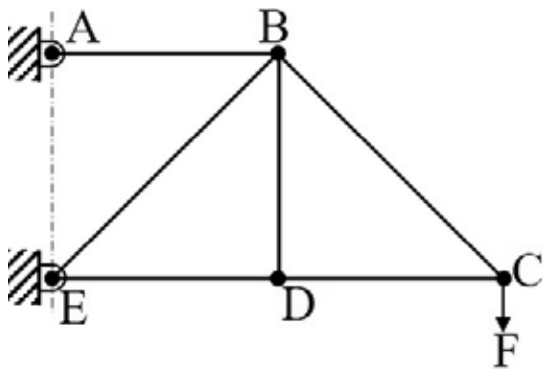
In the truss shown in the figure, all the members are pin jointed to each other. The members AB, BD, DE and DC have the same length. For the given loading, which of the following is the correct statement?
Answer: B
The correct statement is that AB is in tension, ED is in compression, and BD is a zero-force member.
- Joint D: ED and DC are collinear and there is no load, so the only non-collinear member, BD, carries no force.
- Joint C: the load F acts down. Only BC has a vertical component, so BC must pull C upward: BC is in tension. Its horizontal pull towards B must be balanced by DC pushing C to the right, so DC, and with it ED, is in compression.
- Joint B: BC pulls B down and to the right. The diagonal BE must push up, so it is in compression, and that push also has a component to the right. AB must therefore pull B to the left: AB is in tension.
That rules out 'AB and ED in compression', 'DC in tension, BC in compression' and 'ED in tension'.
No comment is present. Be the first to comment.
Loading…
Post your comment
Please log in or register to post a comment.
Examination Categories
- SSC Exams
- Banking Exams
- Teaching Exams
- Civil Services Exams
- Railways Exams
- Engineering Recruitment Exams
- Defence Exams
- State Government Exams
- Police Exams
- Insurance Exams
- Nursing Exams
- Other Government Exams
- NRA CET
- PG Entrance Exams
- Campus Placement
- MBA Entrance Exams
- CUET and UG Entrance
- Judiciary Exams
- Regulatory Body Exams
- Software Development