
Discussion
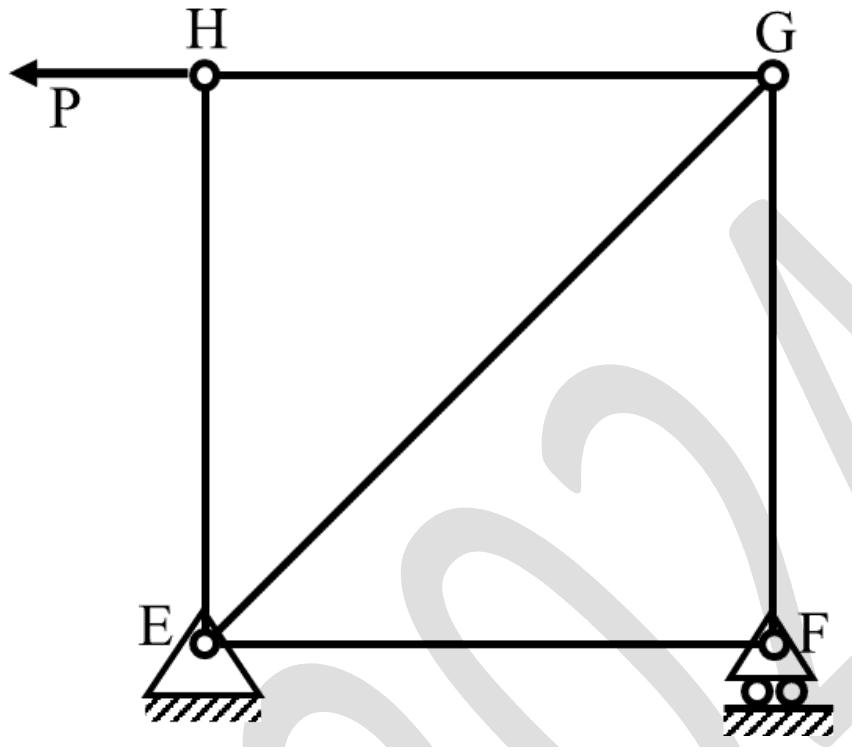
A pin-jointed truss has a pin support at the point E and a roller support at the point F. A horizontal force P is applied at pin H as shown in the figure. Which one of the members is in compression ?
Answer: C
The member in compression is EG.
Taking moments about E, the leftward force P at H (height a) must be balanced by the roller at F, whose reaction is therefore P downwards. Then the joints can be solved in turn:
- Joint H: the only vertical member, EH, has nothing to balance, so EH = 0; HG carries P in tension to balance P.
- Joint F: FG must balance the downward reaction, so FG carries P in tension; EF has no horizontal load, so EF = 0.
- Joint G: tensions in HG and FG pull G left and down by P each, so the diagonal must push G up and to the right: EG is in compression, with force \(P\sqrt{2}\).
EF and EH are zero-force members, and FG is in tension, so only EG is compressed.
No comment is present. Be the first to comment.
Loading…
Post your comment
Please log in or register to post a comment.
Examination Categories
- SSC Exams
- Banking Exams
- Teaching Exams
- Civil Services Exams
- Railways Exams
- Engineering Recruitment Exams
- Defence Exams
- State Government Exams
- Police Exams
- Insurance Exams
- Nursing Exams
- Other Government Exams
- NRA CET
- PG Entrance Exams
- Campus Placement
- MBA Entrance Exams
- CUET and UG Entrance
- Judiciary Exams
- Regulatory Body Exams
- Software Development