
Discussion
If F = 1 kN, the magnitude of the vertical reaction force developed at the point B in kN is
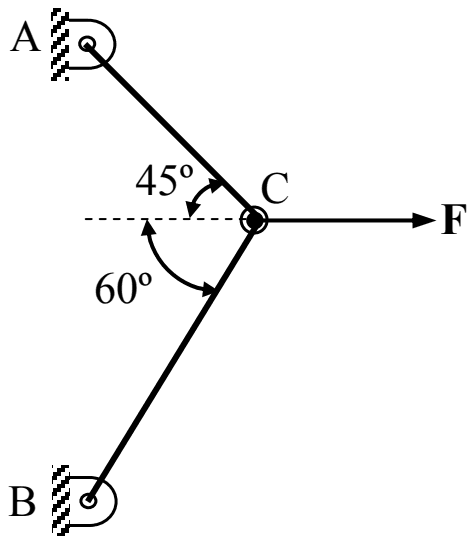
Answer: A
The vertical reaction at B is about 0.63 kN.
Resolve forces at joint C. Let the members carry forces FAC (at 45° above the horizontal) and FBC (at 60° below it), both acting from C towards the wall:
\[ \begin{aligned} F_{AC}\sin 45^{\circ} &= F_{BC}\sin 60^{\circ} \\ F_{AC}\cos 45^{\circ}+F_{BC}\cos 60^{\circ} &= F \end{aligned} \]
The first gives \(F_{AC} = 1.225F_{BC}\); then \(0.866F_{BC}+0.5F_{BC} = 1\), so \(F_{BC} = 0.732\) kN and \(F_{AC} = 0.897\) kN. The vertical reaction at B is the vertical component of FBC:
\[ R_{B} = 0.732 \sin 60^{\circ} = 0.634\ \text{kN} \]
0.32 is half of this, and 1.26 and 1.46 are about twice it; none balances the joint.
Post your comment
Please log in or register to post a comment.
Examination Categories
- SSC Exams
- Banking Exams
- Teaching Exams
- Civil Services Exams
- Railways Exams
- Engineering Recruitment Exams
- Defence Exams
- State Government Exams
- Police Exams
- Insurance Exams
- Nursing Exams
- Other Government Exams
- NRA CET
- PG Entrance Exams
- Campus Placement
- MBA Entrance Exams
- CUET and UG Entrance
- Judiciary Exams
- Regulatory Body Exams
- Software Development