
Discussion
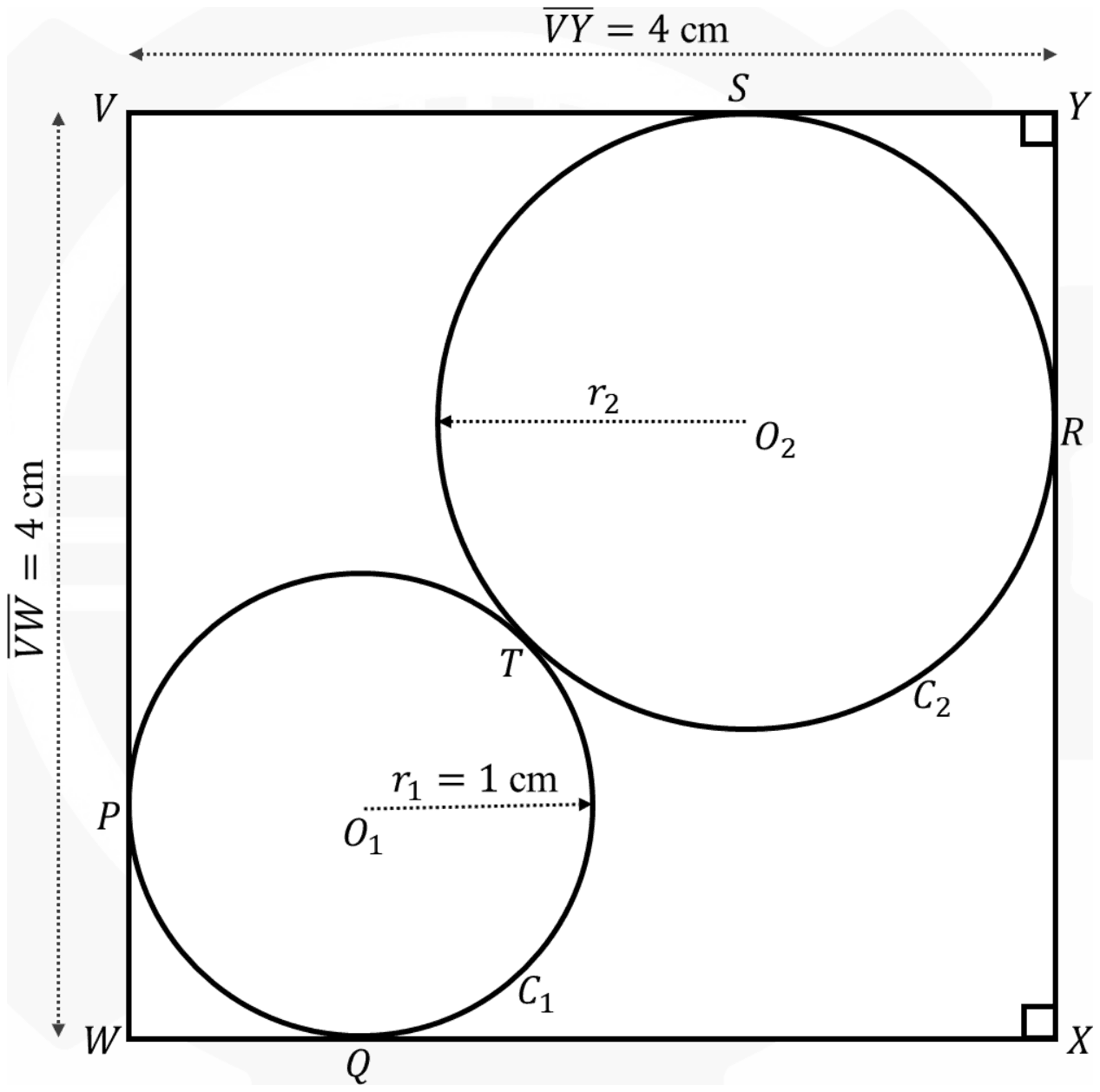
As shown in the figure, circle \(C_1\) with center \(O_1\) and radius \(r_1\) touches the square \(VWXY\) at points \(P\) and \(Q\) while circle \(C_2\) with center \(O_2\) and radius \(r_2\) touches the square \(VWXY\) at points \(R\) and \(S\). The two circles touch each other at \(T\).
Given \(r_1 = 1\) cm and \(\overline{VY} = \overline{VW} = 4\) cm, \(r_2\) = _____ cm.
Answer: C
The radius is \(r_2 =\) \(7 - 4\sqrt{2}\) cm, about 1.34 cm.
Put W at the origin with the square of side 4 cm. \(C_1\) touches the two sides at W, so \(O_1 = (1, 1)\). \(C_2\) touches the two sides at Y, so \(O_2 = (4 - r_2, 4 - r_2)\). Both centres lie on the diagonal WY, and touching circles have centres \(r_1 + r_2\) apart:
\[ \begin{aligned} \sqrt{2}\,(3 - r_2) &= 1 + r_2 \\ r_2 &= \frac{3\sqrt{2} - 1}{\sqrt{2} + 1} \\ &= (3\sqrt{2} - 1)(\sqrt{2} - 1) \\ &= 7 - 4\sqrt{2} \end{aligned} \]
The other values fail a size check: \(4 - 3\sqrt{2}\) is negative, and \(1 + 2\sqrt{2} \approx 3.83\) and \(5 + 3\sqrt{2} \approx 9.24\) would not fit in a 4 cm square beside a 1 cm circle.
Post your comment
Please log in or register to post a comment.
Examination Categories
- SSC Exams
- Banking Exams
- Teaching Exams
- Civil Services Exams
- Railways Exams
- Engineering Recruitment Exams
- Defence Exams
- State Government Exams
- Police Exams
- Insurance Exams
- Nursing Exams
- Other Government Exams
- NRA CET
- PG Entrance Exams
- Campus Placement
- MBA Entrance Exams
- CUET and UG Entrance
- Judiciary Exams
- Regulatory Body Exams
- Software Development