
Discussion
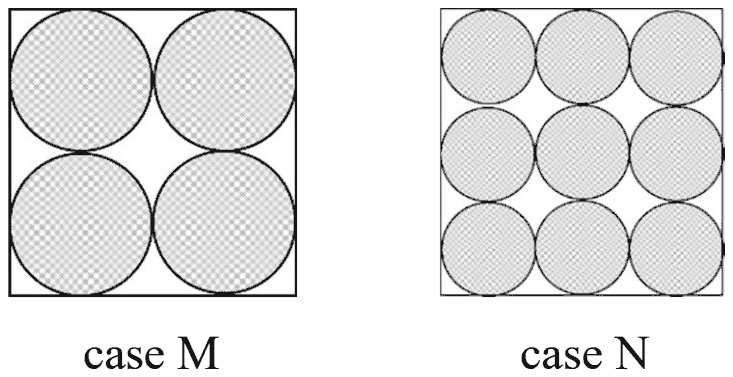
Equal sized circular regions are shaded in a square sheet of paper of 1 cm side length. Two cases, case M and case N, are considered as shown in the figures below. In the case M, four circles are shaded in the square sheet and in the case N, nine circles are shaded in the square sheet as shown.
What is the ratio of the areas of unshaded regions of case M to that of case N?
Answer: B
The ratio is 1 : 1.
In case M, four circles fill the 1 cm square in a 2 by 2 grid, so each has diameter 1/2 cm and radius 1/4 cm. In case N, nine circles fill it in a 3 by 3 grid, so each has radius 1/6 cm. The shaded areas are:
\[ \begin{aligned} M: \; 4 \times \pi \left(\tfrac{1}{4}\right)^{2} &= \tfrac{\pi}{4} \\ N: \; 9 \times \pi \left(\tfrac{1}{6}\right)^{2} &= \tfrac{\pi}{4} \end{aligned} \]
Both unshaded areas are therefore \(1 - \pi/4\) square cm, and the ratio is 1 : 1.
In general, \(n^{2}\) touching circles in an \(n\) by \(n\) grid always cover \(\pi/4\) of the square, whatever \(n\) is. The ratios 2 : 3 and 3 : 2 come from comparing the numbers of circles, 4 and 9, or their rows, instead of their areas.
Post your comment
Please log in or register to post a comment.
Examination Categories
- SSC Exams
- Banking Exams
- Teaching Exams
- Civil Services Exams
- Railways Exams
- Engineering Recruitment Exams
- Defence Exams
- State Government Exams
- Police Exams
- Insurance Exams
- Nursing Exams
- Other Government Exams
- NRA CET
- PG Entrance Exams
- Campus Placement
- MBA Entrance Exams
- CUET and UG Entrance
- Judiciary Exams
- Regulatory Body Exams
- Software Development