
Discussion
The major product formed in the given reaction is

- A.
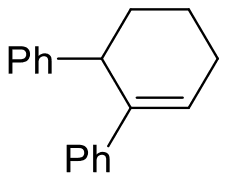
- B.
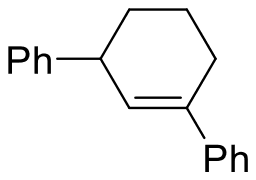
- C.
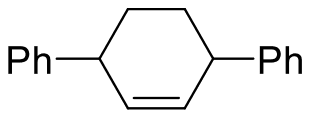
- D.
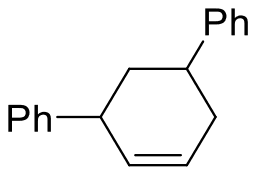
Answer: A
The major product is (A), the 1,6-diphenylcyclohexene.
Fluoride attacks the silicon of 2-(trimethylsilyl)phenyl triflate, and loss of triflate generates benzyne under mild conditions. Benzyne is a reactive enophile, and 1-phenylcyclohexene, with allylic hydrogens, undergoes an aryne ene reaction with it: an allylic hydrogen moves to one aryne carbon while the other aryne carbon bonds to the alkene, and the double bond shifts.
The hydrogen comes from C6, the allylic CH2 next to the phenyl-bearing C1, and the new aryl bond forms at C2, the unsubstituted alkene carbon, which is far less hindered than C1. The double bond moves to C1=C6. The new phenyl (from benzyne plus H) therefore sits on an sp3 carbon next to the vinylic carbon carrying the original phenyl, as in (A).
(B) keeps the double bond where it was and adds the aryl at the other allylic position, which is a substitution, not an ene product. (C) and (D) place the phenyls 1,4 or 1,3 apart, which an ene reaction of this alkene cannot produce.
Post your comment
Please log in or register to post a comment.
Examination Categories
- SSC Exams
- Banking Exams
- Teaching Exams
- Civil Services Exams
- Railways Exams
- Engineering Recruitment Exams
- Defence Exams
- State Government Exams
- Police Exams
- Insurance Exams
- Nursing Exams
- Other Government Exams
- NRA CET
- PG Entrance Exams
- Campus Placement
- MBA Entrance Exams
- CUET and UG Entrance
- Judiciary Exams
- Regulatory Body Exams
- Software Development