
Discussion
The major products X and Y in the following reaction sequence are

- A.
- B.
- C.
- D.
Answer: A
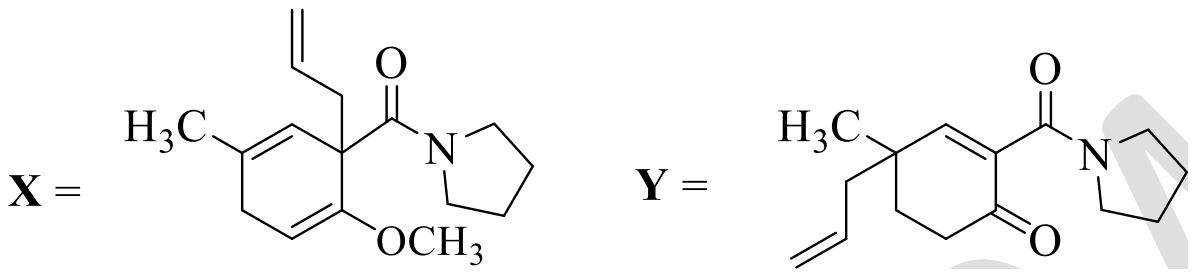
X and Y are the pair shown in (A).
Step 1 is a Birch reductive alkylation: sodium in liquid ammonia reduces the benzamide to an enolate at the amide-bearing carbon, and allyl bromide alkylates that carbon. X is a 1-allyl-1-carboxamide cyclohexa-2,5-diene in which the methoxy group sits on one ring double bond as an enol ether.
Aqueous HCl hydrolyses the enol ether to a ketone next to the quaternary carbon. Refluxing in 1,2-dichlorobenzene then drives a [3,3]-sigmatropic (Cope) rearrangement of the 1,5-diene formed by the allyl group and the remaining ring double bond: the allyl group moves to the methyl-bearing carbon and a new C=C forms at the amide carbon, conjugated with both carbonyls. That is Y in (A).
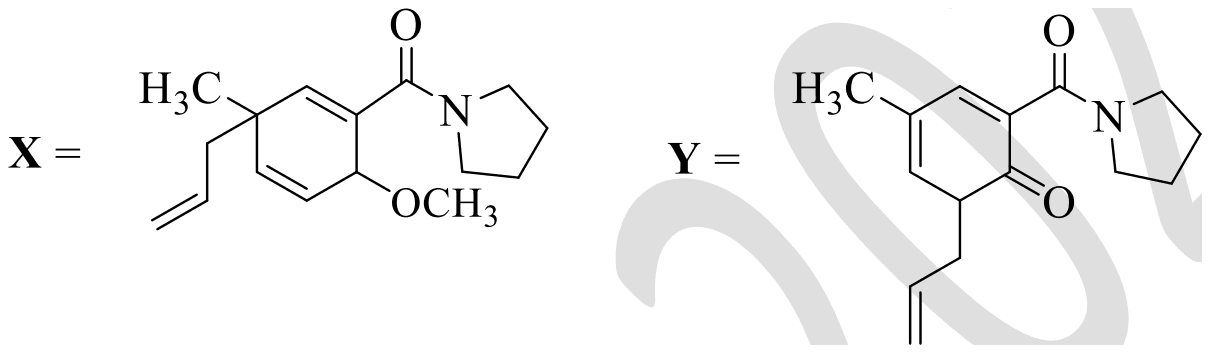
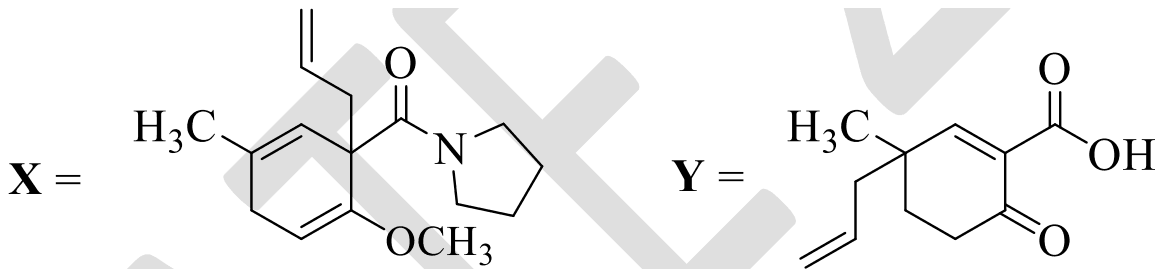
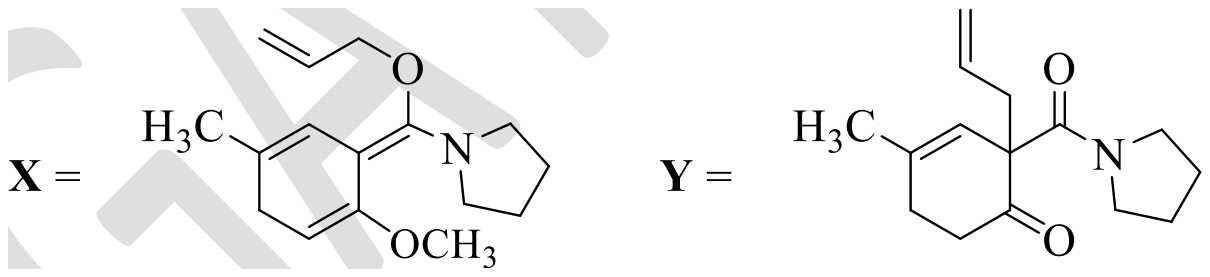
(B) and (D) put the allyl group in the wrong place in X (on carbon or on oxygen), and (C) wrongly converts the amide to an acid, which aqueous HCl at this stage does not do.
Post your comment
Please log in or register to post a comment.
Examination Categories
- SSC Exams
- Banking Exams
- Teaching Exams
- Civil Services Exams
- Railways Exams
- Engineering Recruitment Exams
- Defence Exams
- State Government Exams
- Police Exams
- Insurance Exams
- Nursing Exams
- Other Government Exams
- NRA CET
- PG Entrance Exams
- Campus Placement
- MBA Entrance Exams
- CUET and UG Entrance
- Judiciary Exams
- Regulatory Body Exams
- Software Development