
Discussion
The non-aromatic compound/ion is
- A.
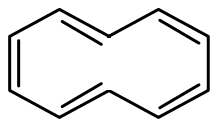
- B.
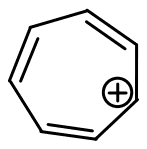
- C.
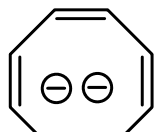
- D.

Answer: A
The non-aromatic species is (A), the ten-membered ring cyclodecapentaene ([10]annulene).
It has 10 pi electrons, which satisfies the 4n + 2 rule for n = 2, but a planar all-cis ten-membered ring would have very strained bond angles, and the isomer drawn would put two inner hydrogens on top of each other. The ring therefore twists out of plane, the p orbitals cannot overlap all round, and the compound behaves as a non-aromatic polyene.
The cycloheptatrienyl (tropylium) cation (B) has 6 pi electrons in a planar ring and the cyclooctatetraene dianion (C) has 10; both are aromatic. The cyclopentadienyl cation (D) has 4 pi electrons in a planar ring and is antiaromatic, which is different from non-aromatic: it is destabilised by cyclic conjugation rather than simply lacking it.
Post your comment
Please log in or register to post a comment.
Examination Categories
- SSC Exams
- Banking Exams
- Teaching Exams
- Civil Services Exams
- Railways Exams
- Engineering Recruitment Exams
- Defence Exams
- State Government Exams
- Police Exams
- Insurance Exams
- Nursing Exams
- Other Government Exams
- NRA CET
- PG Entrance Exams
- Campus Placement
- MBA Entrance Exams
- CUET and UG Entrance
- Judiciary Exams
- Regulatory Body Exams
- Software Development