
Discussion
The major product W formed in the following reaction is

- A.

- B.

- C.

- D.
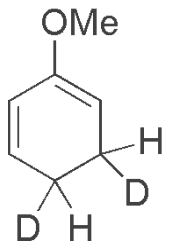
Answer: B
The major product W is the 1-methoxycyclohexa-1,4-diene carrying a hydrogen and a deuterium on each of its two CH2 carbons, which is option (B).
Na in liquid NH3 with an alcohol is the Birch reduction. The methoxy group is electron donating, so the radical anion is protonated at the ortho and meta positions, leaving the methoxy carbon on a double bond in the product. EtOD is the proton source, so the two new hydrogens are deuterium. Two carbons become sp3: the one ortho to OMe and the one meta to it (para to the first), and each ends up as CHD, because one H was already present and one D is added.
Option (A) puts D on the methoxy carbon and reduces the para positions, which is the pattern for an electron-withdrawing substituent. Options (C) and (D) put the new sp3 carbons on the wrong positions, so they are not the 1,4-diene.
Post your comment
Please log in or register to post a comment.
Examination Categories
- SSC Exams
- Banking Exams
- Teaching Exams
- Civil Services Exams
- Railways Exams
- Engineering Recruitment Exams
- Defence Exams
- State Government Exams
- Police Exams
- Insurance Exams
- Nursing Exams
- Other Government Exams
- NRA CET
- PG Entrance Exams
- Campus Placement
- MBA Entrance Exams
- CUET and UG Entrance
- Judiciary Exams
- Regulatory Body Exams
- Software Development