
Discussion
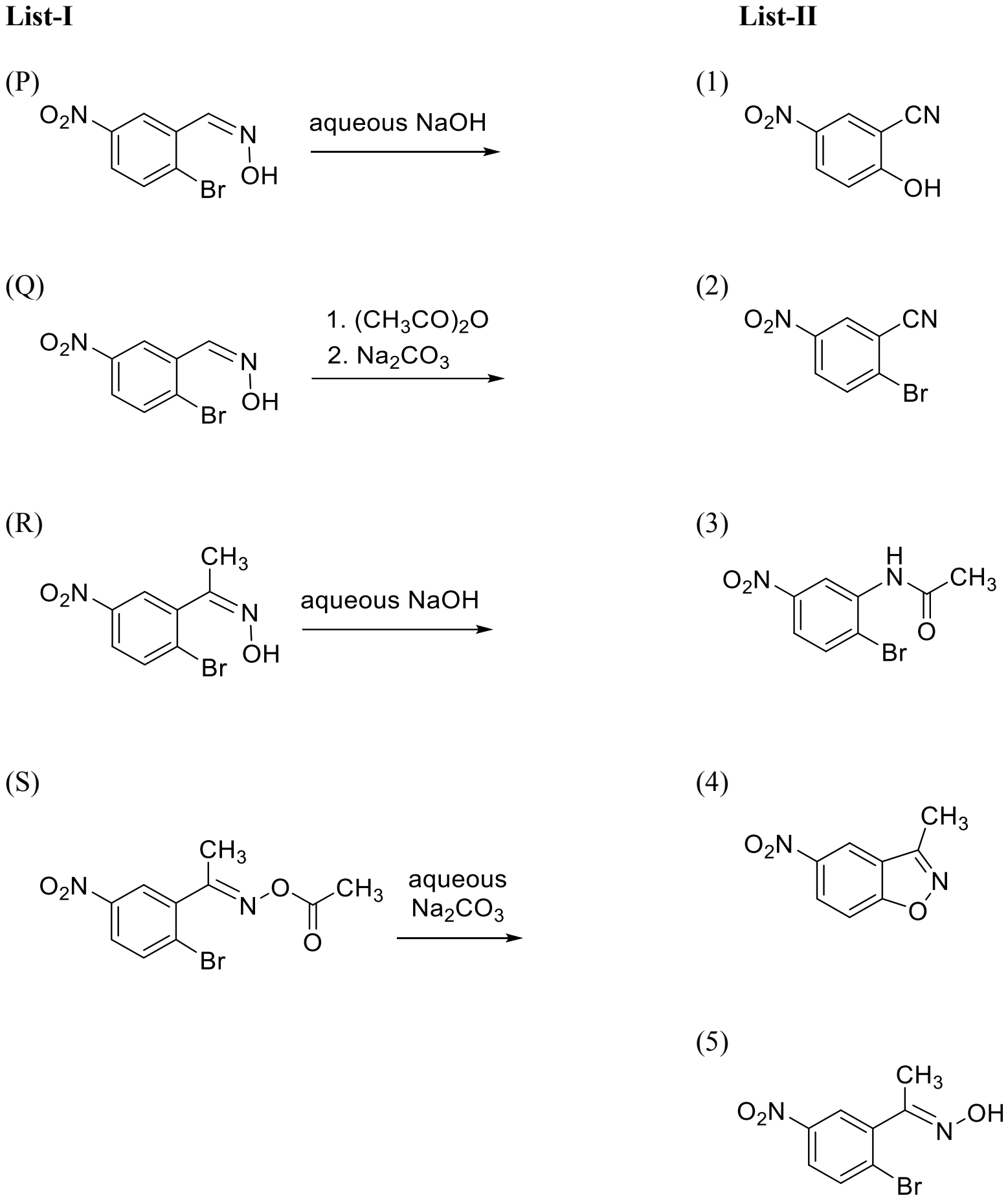
Match the major products obtained in the reactions given in List-I with the corresponding structures in List-II and choose the correct option.
Answer: B
The correct match is P → 1, Q → 2, R → 4, S → 5.
(P) The aldoxime has its OH on the side nearest the ring bromine. Aqueous NaOH forms the oximate, which displaces the activated bromide (it is ortho to the oxime carbon and para to the nitro group) to give a 1,2-benzisoxazole with no substituent at C-3. With a hydrogen at C-3, base opens it (Kemp elimination) to the 2-cyanophenol: (1).
(Q) Acetic anhydride acetylates the oxime OH, and Na2CO3 then eliminates acetic acid from the aldoxime acetate to give the nitrile with the bromine unchanged: (2).
(R) The ketoxime closes in the same way, but the methyl group at C-3 prevents ring opening, so the benzisoxazole stays: (4).
(S) This oxime acetate has the O-acetyl group on the side away from the ring, so it cannot cyclize. Aqueous carbonate simply hydrolyses the acetate back to the oxime: (5). The anilide (3) would need an acid-catalysed Beckmann rearrangement.
Post your comment
Please log in or register to post a comment.
Examination Categories
- SSC Exams
- Banking Exams
- Teaching Exams
- Civil Services Exams
- Railways Exams
- Engineering Recruitment Exams
- Defence Exams
- State Government Exams
- Police Exams
- Insurance Exams
- Nursing Exams
- Other Government Exams
- NRA CET
- PG Entrance Exams
- Campus Placement
- MBA Entrance Exams
- CUET and UG Entrance
- Judiciary Exams
- Regulatory Body Exams
- Software Development