
Discussion
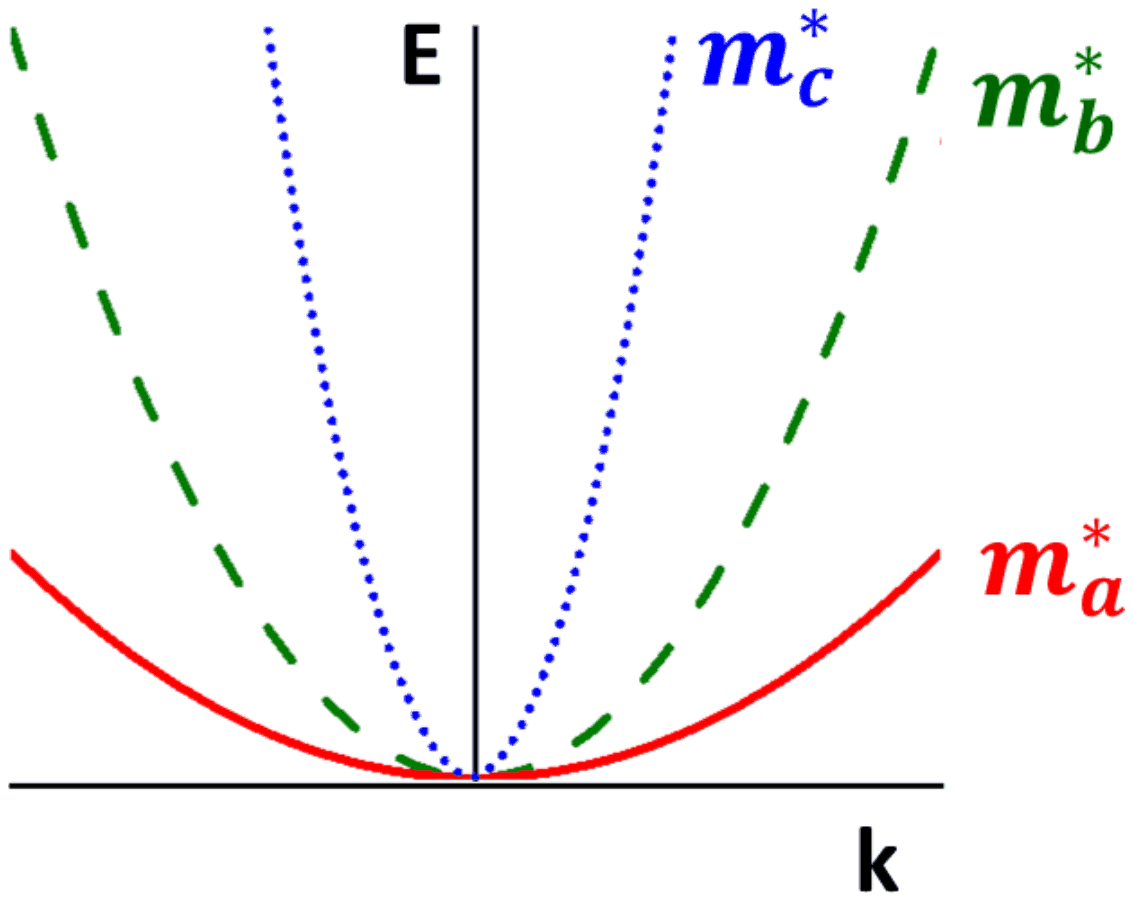
For nonrelativistic electrons in a solid, different energy dispersion relations (with effective masses \(m_{a}^{*}\), \(m_{b}^{*}\), and \(m_{c}^{*}\)) are schematically shown in the plots. Which one of the following options is CORRECT?
Answer: D
The correct order is \(m_{a}^{*} \gt m_{b}^{*} \gt m_{c}^{*}\).
For free-electron-like bands,
\[ \begin{aligned} E &= \frac{\hbar^{2}k^{2}}{2m^{*}} \\ \frac{1}{m^{*}} &= \frac{1}{\hbar^{2}}\frac{d^{2}E}{dk^{2}} \end{aligned} \]
so the effective mass is inversely proportional to the curvature of \(E(k)\). The \(m_{c}^{*}\) band is the narrowest, most sharply curved parabola, so its effective mass is the smallest; the \(m_{a}^{*}\) band is the flattest, so its mass is the largest; \(m_{b}^{*}\) lies between.
Equal masses would need identical parabolas, and the other two orders put a sharply curved band above a flatter one, which reverses the relation.
Post your comment
Please log in or register to post a comment.
Examination Categories
- SSC Exams
- Banking Exams
- Teaching Exams
- Civil Services Exams
- Railways Exams
- Engineering Recruitment Exams
- Defence Exams
- State Government Exams
- Police Exams
- Insurance Exams
- Nursing Exams
- Other Government Exams
- NRA CET
- PG Entrance Exams
- Campus Placement
- MBA Entrance Exams
- CUET and UG Entrance
- Judiciary Exams
- Regulatory Body Exams
- Software Development