
Discussion
Plot of the modulus versus temperature of different types of polymers is given below. Based on this plot and the nature of the polymers as mentioned below, find out the correct combination.
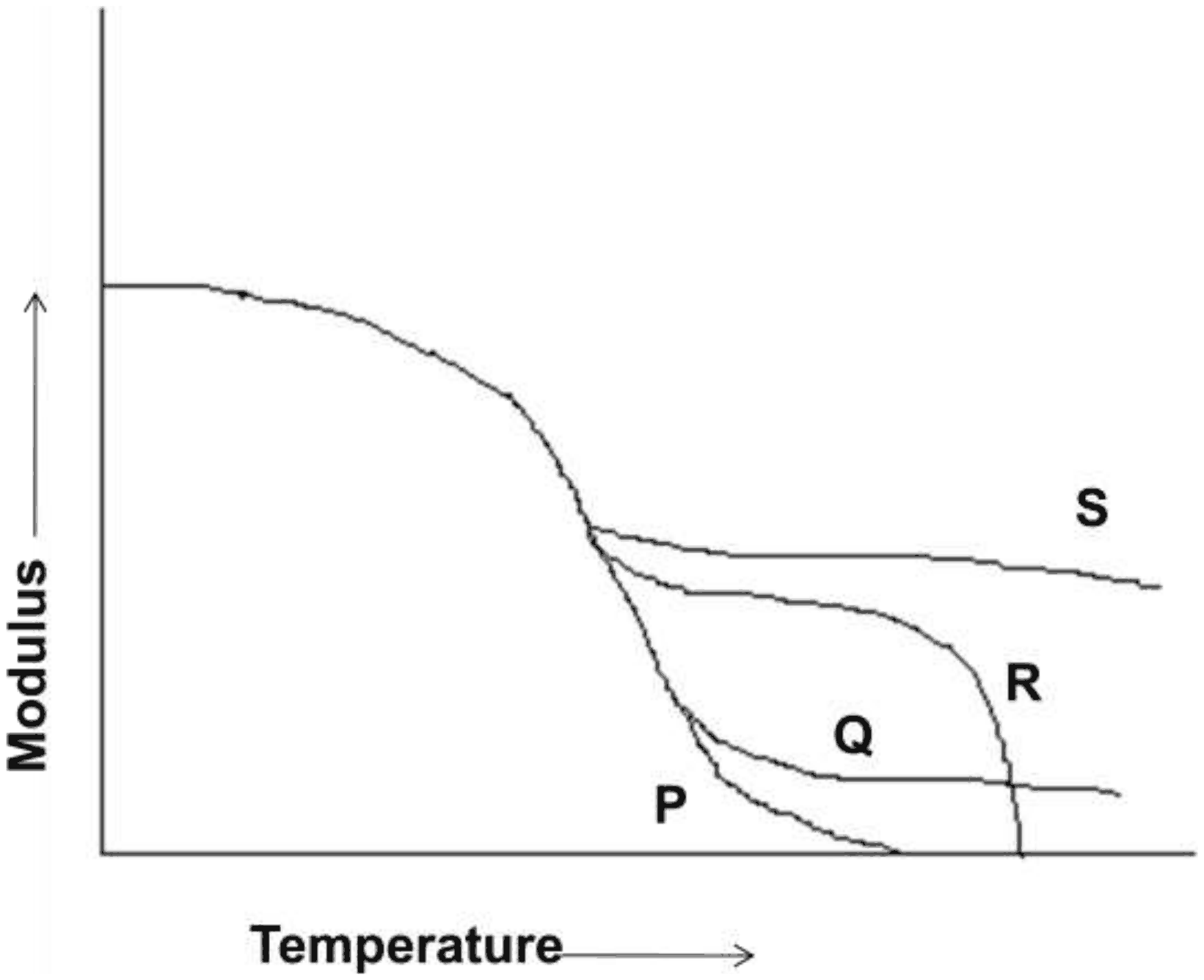
1 = An amorphous polymer of high molecular weight having entanglements
2 = An amorphous polymer of moderate molecular weight
3 = Highly crosslinked polymer
4 = Semi-crystalline polymer
Answer: C
The match is P-2; Q-1; R-4; S-3.
All four polymers share the glassy plateau and the fall in modulus through the glass transition. What follows tells them apart:
- P drops straight to zero, flowing as soon as it softens: an amorphous polymer of moderate molecular weight, with too few entanglements for a rubbery plateau.
- Q levels off at a low rubbery plateau before slowly declining: entanglements in a high molecular weight amorphous polymer act as temporary crosslinks.
- R holds a higher plateau that ends abruptly: a semi-crystalline polymer, stiffened by its crystallites until they melt.
- S keeps a high, nearly flat modulus to the highest temperatures: a highly crosslinked polymer, which cannot flow.
Options assigning the crosslinked polymer to R or the semi-crystalline polymer to S get the end of the plateau wrong.
No comment is present. Be the first to comment.
Loading…
Post your comment
Please log in or register to post a comment.
Examination Categories
- SSC Exams
- Banking Exams
- Teaching Exams
- Civil Services Exams
- Railways Exams
- Engineering Recruitment Exams
- Defence Exams
- State Government Exams
- Police Exams
- Insurance Exams
- Nursing Exams
- Other Government Exams
- NRA CET
- PG Entrance Exams
- Campus Placement
- MBA Entrance Exams
- CUET and UG Entrance
- Judiciary Exams
- Regulatory Body Exams
- Software Development