
Discussion
During material testing, stress is applied from time \(t_{i}\) to \(t_{f}\) as shown below:
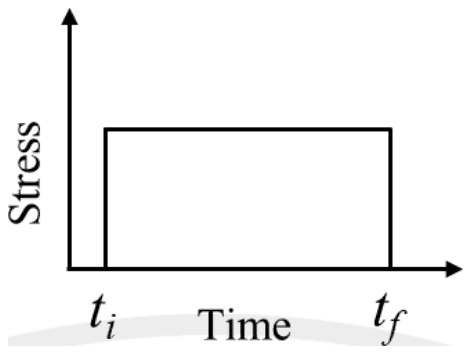
The corresponding strain responses for three different materials are shown in plots P, Q and R.
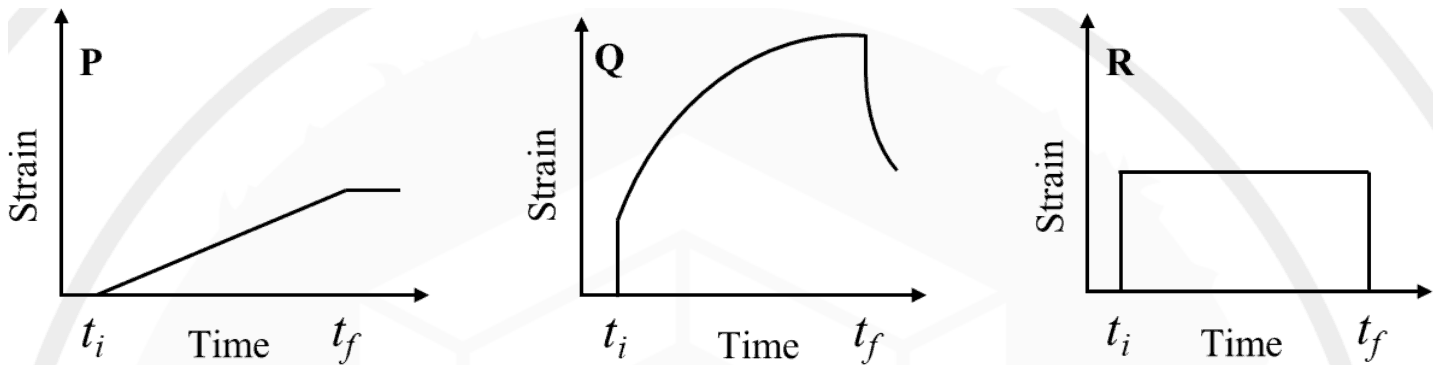
Choose the option(s) where the strain response is correctly mapped to its material class.
Answer: D
The correct mapping is P- purely viscous; Q- viscoelastic; R- purely elastic.
- P: under a constant stress the strain grows linearly with time and stays where it is when the stress is removed. That is a Newtonian dashpot, flow without recovery: purely viscous.
- Q: the strain jumps at once, then keeps creeping upward under load; on unloading it drops partly at once and then recovers gradually. The instant parts are elastic and the time-dependent parts viscous: viscoelastic.
- R: the strain appears instantly, stays constant while the stress is held and vanishes instantly when it is removed: purely elastic, a Hookean spring.
The other options give the linear creep of P to an elastic solid, which would not creep at all, or call the step response R viscoelastic, though it shows no time dependence.
No comment is present. Be the first to comment.
Loading…
Post your comment
Please log in or register to post a comment.
Examination Categories
- SSC Exams
- Banking Exams
- Teaching Exams
- Civil Services Exams
- Railways Exams
- Engineering Recruitment Exams
- Defence Exams
- State Government Exams
- Police Exams
- Insurance Exams
- Nursing Exams
- Other Government Exams
- NRA CET
- PG Entrance Exams
- Campus Placement
- MBA Entrance Exams
- CUET and UG Entrance
- Judiciary Exams
- Regulatory Body Exams
- Software Development