
Discussion
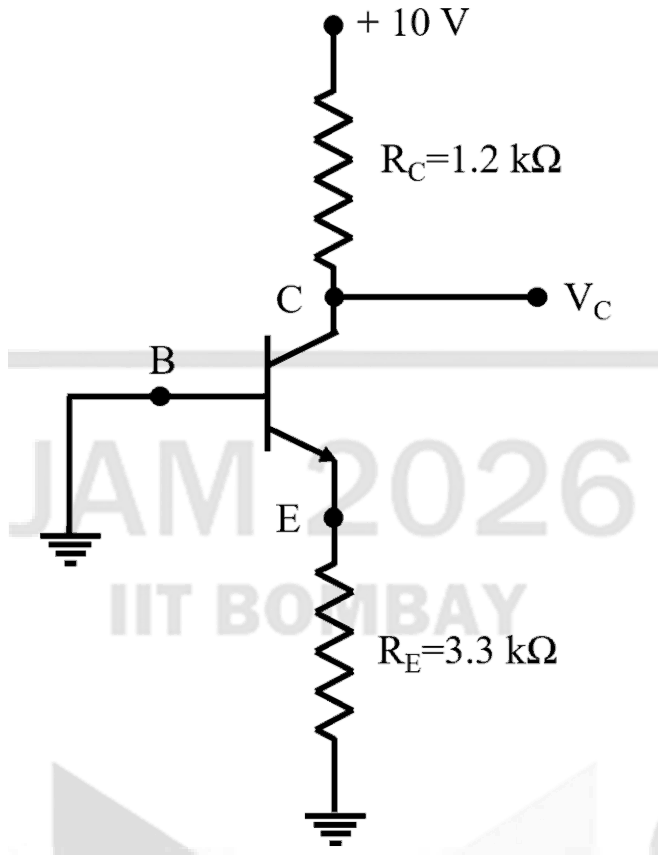
Consider the circuit of the figure, the voltage Vc , in Volts, is:
Answer: D
\(V_C\) is 10 V.
For an npn transistor to conduct, its base-emitter junction must be forward biased by about 0.7 V, with the base above the emitter. Here the base is tied to ground (0 V) and the emitter returns to ground through \(R_E\), with no negative supply. The emitter can never be pulled below 0 V, so \(V_{BE} \le 0\) and the transistor is cut off.
With no collector current there is no drop across \(R_C\):
\[ V_C = 10 - I_C R_C = 10 - 0 = 10\ \text{V} \]
0 V would describe a short to ground, and 9.8 V or 1.25 V would need a collector current to flow, which assumes the transistor is biased on. The values of \(R_C\) and \(R_E\) do not enter at all.
Post your comment
Please log in or register to post a comment.
Examination Categories
- SSC Exams
- Banking Exams
- Teaching Exams
- Civil Services Exams
- Railways Exams
- Engineering Recruitment Exams
- Defence Exams
- State Government Exams
- Police Exams
- Insurance Exams
- Nursing Exams
- Other Government Exams
- NRA CET
- PG Entrance Exams
- Campus Placement
- MBA Entrance Exams
- CUET and UG Entrance
- Judiciary Exams
- Regulatory Body Exams
- Software Development