
Discussion
For the fixed bias configuration of BJT as shown in figure of silicon BJT having ratio of collector current to base current (β) equal to 95, what will be the value of VCE ?
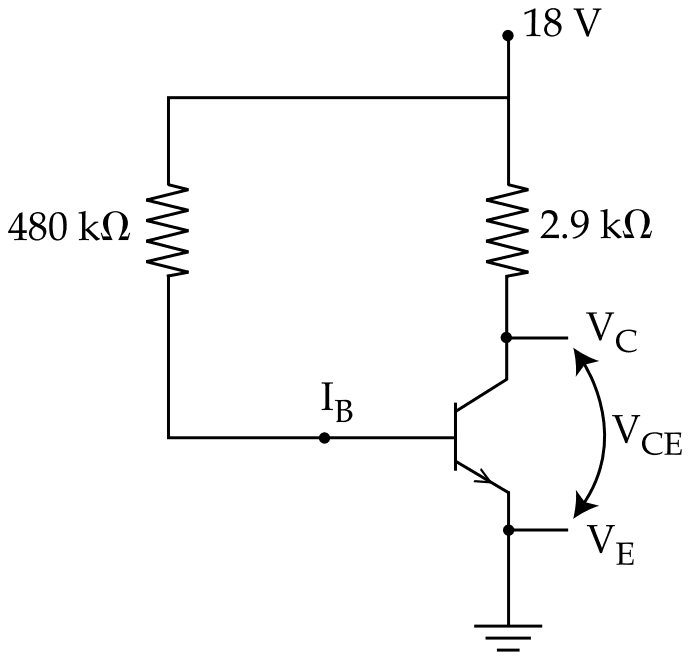
Answer: B
VCE works out to about 8.08 V.
In the fixed-bias circuit the base current comes from the 18 V supply through the 480 kΩ resistor, less the 0.7 V base-emitter drop of a silicon transistor. The collector current is β times that, and VCE is the supply minus the drop across the 2.9 kΩ collector resistor.
\[ \begin{aligned} I_{B} &= \frac{18 - 0.7}{480\ \text{k}\Omega} \approx 36\ \mu\text{A} \\ I_{C} &= 95 \times 36\ \mu\text{A} = 3.42\ \text{mA} \end{aligned} \]
\[ \begin{aligned} V_{CE} &= 18 - 3.42\ \text{mA} \times 2.9\ \text{k}\Omega \\ &= 18 - 9.92 = 8.08\ \text{V} \end{aligned} \]
Carrying more decimal places gives 8.07 V, so 8.08 V is the option the working lands on. Leaving out the 0.7 V drop gives about 7.67 V, and 7 V and 8 V are round figures that do not follow from the circuit values.
Post your comment
Please log in or register to post a comment.
Examination Categories
- SSC Exams
- Banking Exams
- Teaching Exams
- Civil Services Exams
- Railways Exams
- Engineering Recruitment Exams
- Defence Exams
- State Government Exams
- Police Exams
- Insurance Exams
- Nursing Exams
- Other Government Exams
- NRA CET
- PG Entrance Exams
- Campus Placement
- MBA Entrance Exams
- CUET and UG Entrance
- Judiciary Exams
- Regulatory Body Exams
- Software Development