
Discussion
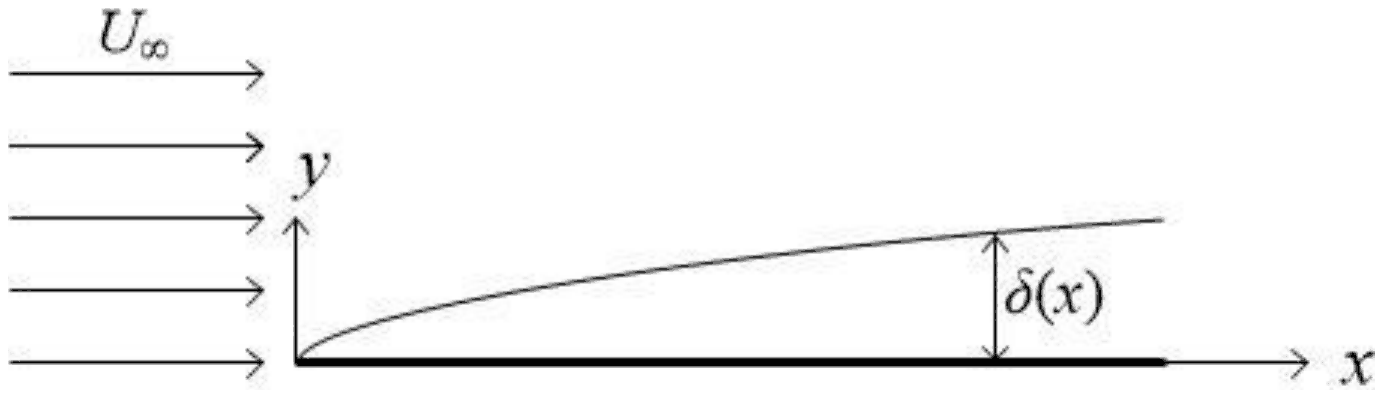
Consider steady incompressible flow of a Newtonian fluid over a horizontal flat plate, as shown in the figure. The boundary layer thickness is proportional to
Answer: B
The boundary layer thickness grows as \(x^{1/2}\).
For laminar flow over a flat plate, an order-of-magnitude balance of inertia and viscous diffusion in the boundary layer gives \(\frac{U_{\infty}}{x} \sim \frac{\nu}{\delta^{2}}\), so \(\delta \sim \sqrt{\nu x/U_{\infty}}\). The Blasius solution makes this exact:
\[ \begin{aligned} \delta &\approx \frac{5x}{\sqrt{Re_{x}}} = 5\sqrt{\frac{\nu x}{U_{\infty}}} \\ &\propto x^{1/2} \end{aligned} \]
\(x^{-1/2}\) is how the local skin friction coefficient varies, not the thickness, which must grow downstream. \(x^{2}\) grows far too fast, and \(x^{1/4}\) has no basis here; a turbulent layer grows faster, as about \(x^{4/5}\).
Post your comment
Please log in or register to post a comment.
Examination Categories
- SSC Exams
- Banking Exams
- Teaching Exams
- Civil Services Exams
- Railways Exams
- Engineering Recruitment Exams
- Defence Exams
- State Government Exams
- Police Exams
- Insurance Exams
- Nursing Exams
- Other Government Exams
- NRA CET
- PG Entrance Exams
- Campus Placement
- MBA Entrance Exams
- CUET and UG Entrance
- Judiciary Exams
- Regulatory Body Exams
- Software Development