
Discussion
Consider the control flow graph given below.
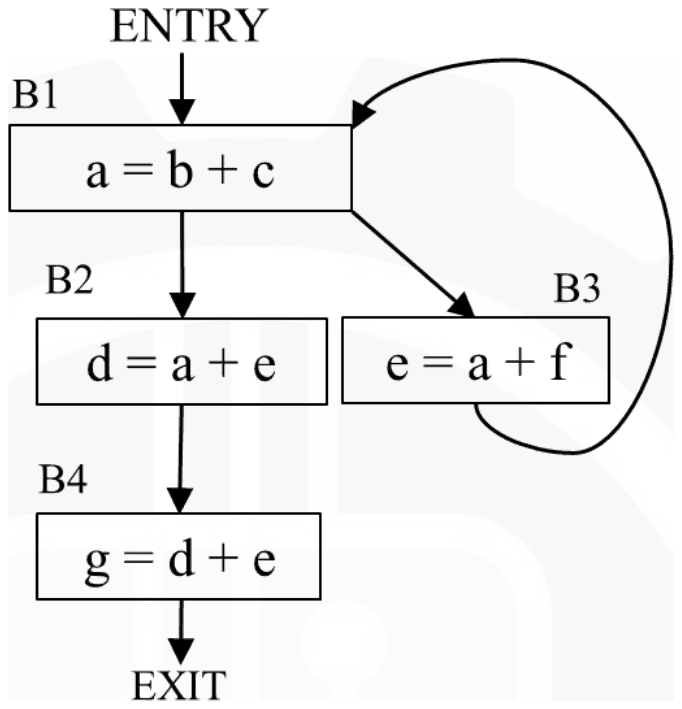
Which one of the following options is the set of live variables at the exit point of each basic block?
Answer: A
The live variables at block exits are B1:{a, b, c, e, f}, B2:{d, e}, B3:{b, c, e, f}, B4:∅.
Liveness flows backwards: OUT(B) is the union of IN over B's successors, and IN(B) = USE(B) ∪ (OUT(B) - DEF(B)). The edges are B1 → B2, B1 → B3, B3 → B1 and B2 → B4.
- B4 (g = d + e) leads to EXIT, and g is never used: OUT(B4) = ∅, IN(B4) = {d, e}.
- B2 (d = a + e): OUT(B2) = IN(B4) = {d, e}; IN(B2) = {a, e}.
- B1 (a = b + c) and B3 (e = a + f) form a loop. Iterating to a fixed point: IN(B1) = {b, c, e, f} and IN(B3) = {a, b, c, f}.
- OUT(B1) = IN(B2) ∪ IN(B3) = {a, b, c, e, f}; OUT(B3) = IN(B1) = {b, c, e, f}.
The options with B1:∅ ignore that a is used in both successors of B1. The option with B3:{c, e, f} drops b, which is live because B1, reached from B3, uses it.
No comment is present. Be the first to comment.
Loading…
Post your comment
Please log in or register to post a comment.
Examination Categories
- SSC Exams
- Banking Exams
- Teaching Exams
- Civil Services Exams
- Railways Exams
- Engineering Recruitment Exams
- Defence Exams
- State Government Exams
- Police Exams
- Insurance Exams
- Nursing Exams
- Other Government Exams
- NRA CET
- PG Entrance Exams
- Campus Placement
- MBA Entrance Exams
- CUET and UG Entrance
- Judiciary Exams
- Regulatory Body Exams
- Software Development