
Discussion
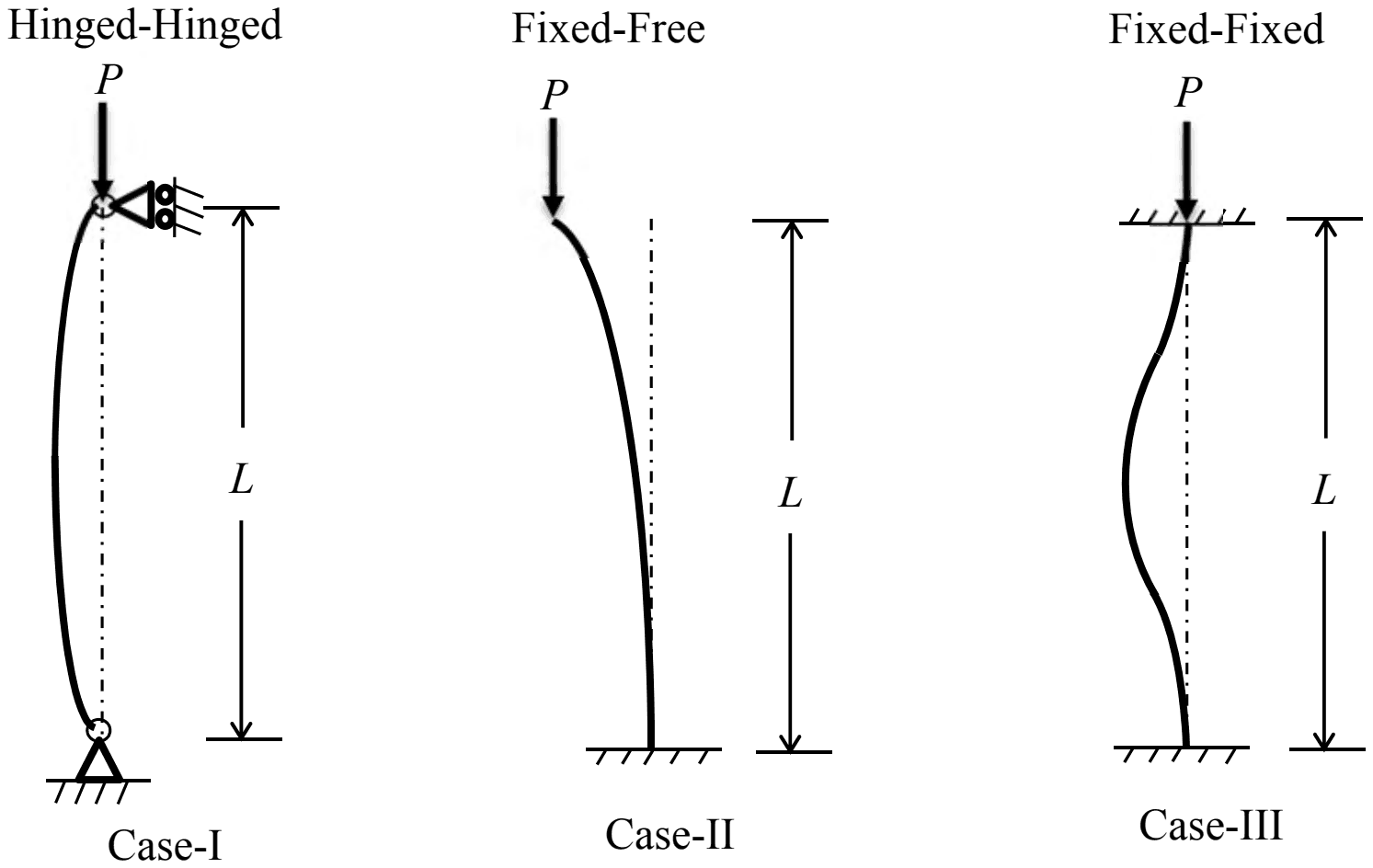
The effective lengths of the columns with ideal boundary conditions shown in Case-I, Case-II, and Case-III are respectively
Answer: D
The effective lengths are \(L\), \(2L\), \(L/2\).
The effective length is the length of a pin-ended column that buckles at the same load, measured between points of zero moment (inflection points) in the buckled shape:
- Hinged-hinged: the whole column is one half sine wave, so \(L_{e} = L\).
- Fixed-free: the column is half of a pin-ended half wave, so \(L_{e} = 2L\).
- Fixed-fixed: the inflection points lie at \(L/4\) from each end, leaving \(L/2\) between them, so \(L_{e} = L/2\).
The options with \(4L\) or \(L/4\) confuse the effective length with the factor in the buckling load (\(P_{cr}\) changes by 1/4 and by 4 for these cases), and \(L, L, L\) ignores the end conditions.
No comment is present. Be the first to comment.
Loading…
Post your comment
Please log in or register to post a comment.
Examination Categories
- SSC Exams
- Banking Exams
- Teaching Exams
- Civil Services Exams
- Railways Exams
- Engineering Recruitment Exams
- Defence Exams
- State Government Exams
- Police Exams
- Insurance Exams
- Nursing Exams
- Other Government Exams
- NRA CET
- PG Entrance Exams
- Campus Placement
- MBA Entrance Exams
- CUET and UG Entrance
- Judiciary Exams
- Regulatory Body Exams
- Software Development