
Discussion
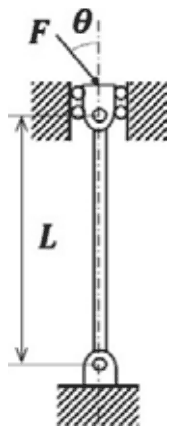
A force \(F\) is applied at an angle \(\theta = 30^{o}\) on an elastic column as shown in the figure. \(E\) and \(I\) are respectively the Young’s modulus and area moment of inertia. The smallest magnitude of \(F\) needed to cause buckling is
Answer: A
The smallest force is \(\frac{2}{\sqrt{3}}\frac{\pi^{2}EI}{L^{2}}\).
The column is pinned at both ends: the top pin runs in a vertical guide that carries the horizontal component of F. Only the axial component \(F\cos\theta\) compresses the column, and buckling starts when it reaches the Euler load for a pinned-pinned column:
\[ \begin{aligned} F\cos 30^{\circ} &= \frac{\pi^{2}EI}{L^{2}} \\ F &= \frac{2}{\sqrt{3}}\frac{\pi^{2}EI}{L^{2}} \end{aligned} \]
\(\frac{\sqrt{3}}{2}\frac{\pi^{2}EI}{L^{2}}\) multiplies by \(\cos\theta\) instead of dividing. \(\pi^{2}EI/(2L^{2})\) and \(2\pi^{2}EI/L^{2}\) come from other end conditions (fixed-pinned gives about \(2.05\pi^{2}EI/L^{2}\)) and also ignore the inclination.
Post your comment
Please log in or register to post a comment.
Examination Categories
- SSC Exams
- Banking Exams
- Teaching Exams
- Civil Services Exams
- Railways Exams
- Engineering Recruitment Exams
- Defence Exams
- State Government Exams
- Police Exams
- Insurance Exams
- Nursing Exams
- Other Government Exams
- NRA CET
- PG Entrance Exams
- Campus Placement
- MBA Entrance Exams
- CUET and UG Entrance
- Judiciary Exams
- Regulatory Body Exams
- Software Development