
Discussion
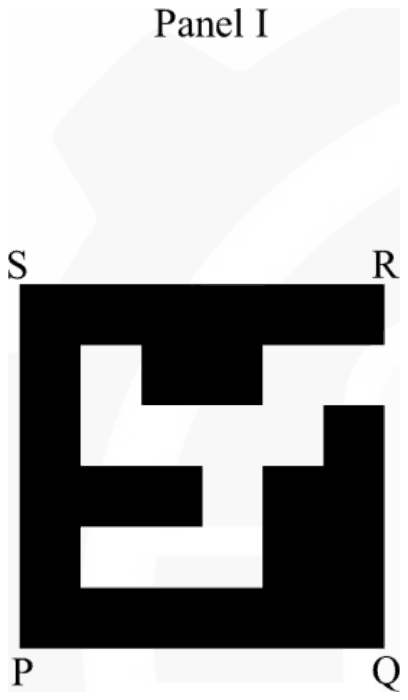
A black square PQRS has been cut into two parts. One part of it is shown in Panel I. Which one of the shapes in Panel II is the other part?
- A.

- B.

- C.

- D.

Answer: C
The other part is shape (iii).
Read Panel I as a 6 by 6 grid of unit squares, columns numbered 1 to 6 from the left. The white region, which the missing part must fill exactly, lies in rows 2 to 5:
- row 2: column 2, and columns 5 and 6 against the right edge;
- row 3: columns 2 to 5, a bar of four;
- row 4: column 4 alone, a one-square neck;
- row 5: columns 2 to 4, a bar of three.
Shape (iii) has exactly this outline: a single square and a two-square block on top, a bar of four, a one-square neck under its third square, and a bar of three at the bottom ending under the neck. It fits without rotation.
Shape (i) has a bottom bar of four squares, one too many. Shape (ii) has its bottom bar shifted one square to the right. Shape (iv) has a neck two squares wide and a bottom bar of two, so neither matches the cut-out.
Post your comment
Please log in or register to post a comment.
Examination Categories
- SSC Exams
- Banking Exams
- Teaching Exams
- Civil Services Exams
- Railways Exams
- Engineering Recruitment Exams
- Defence Exams
- State Government Exams
- Police Exams
- Insurance Exams
- Nursing Exams
- Other Government Exams
- NRA CET
- PG Entrance Exams
- Campus Placement
- MBA Entrance Exams
- CUET and UG Entrance
- Judiciary Exams
- Regulatory Body Exams
- Software Development