
Discussion
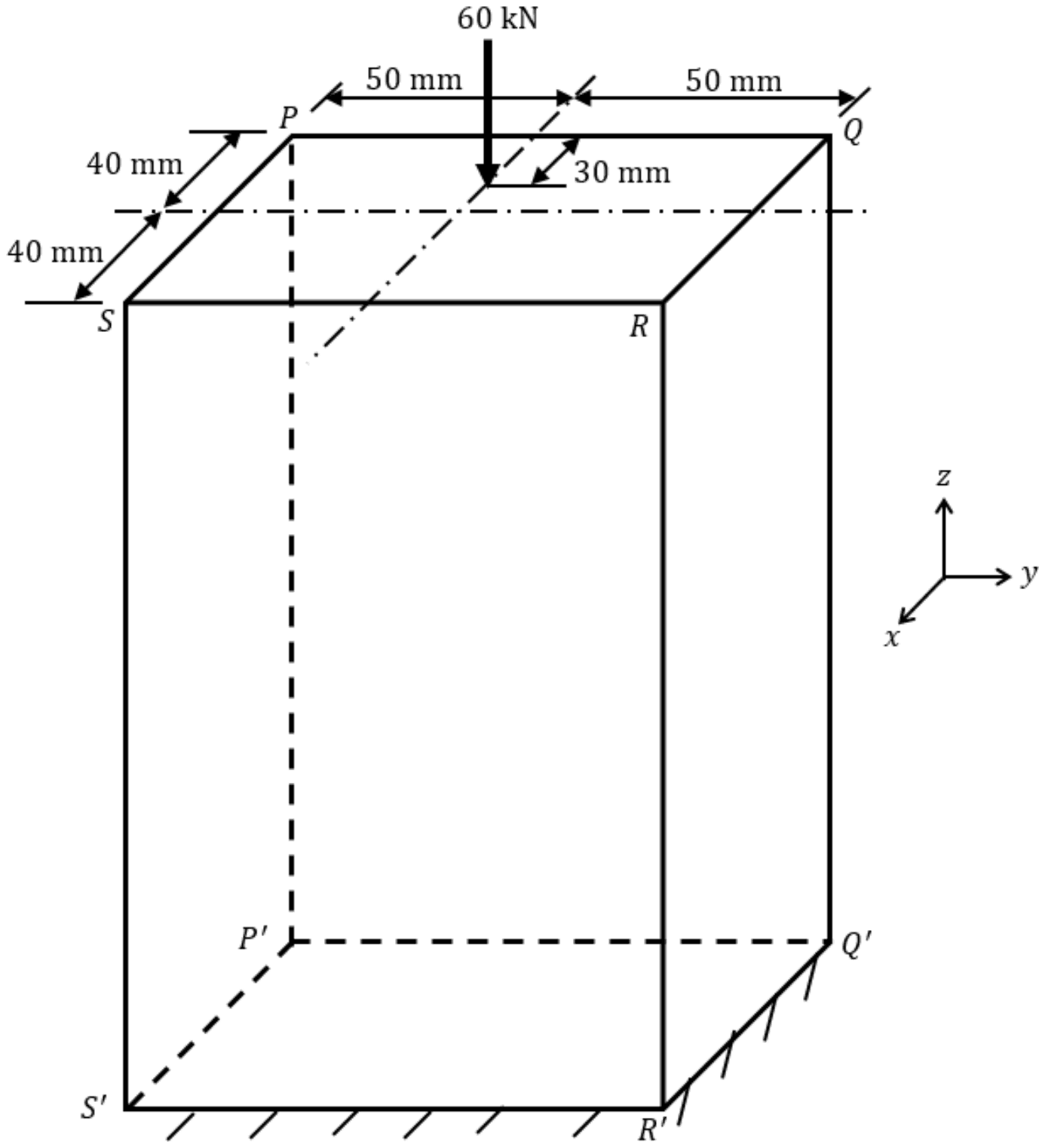
The figure shows a column of rectangular cross section 100 mm × 80 mm. It carries a load of 60 kN at a point 30 mm from the edge \(PQ\). The values of stress component \(\sigma_{zz}\) on surfaces \(PQQ'P'\) and \(SRR'S'\), at points far away from both ends of the column, are respectively
Answer: D
The stresses are 13.13 N/mm2 (Compressive) and 1.88 N/mm2 (Compressive).
The section is 100 mm along \(PQ\) and 80 mm across. The load is 30 mm from \(PQ\), so it is offset \(e = 40 - 30 = 10\) mm from the centroid towards \(PQ\), and centred along \(PQ\). Direct and bending stresses:
\[ \begin{aligned} \sigma_{d} &= \frac{60000}{100 \times 80} = 7.5\ \text{N/mm}^{2} \\ \sigma_{b} &= \frac{6Pe}{bh^{2}} = \frac{6 \times 60000 \times 10}{100 \times 80^{2}} \\ &= 5.625\ \text{N/mm}^{2} \end{aligned} \]
On face \(PQQ'P'\), nearer the load, the two add: \(7.5 + 5.625 = 13.13\) compressive. On face \(SRR'S'\) they subtract: \(7.5 - 5.625 = 1.88\), still compressive, because the load lies inside the middle third (the kern, \(e \le 80/6 \approx 13.3\) mm) and the section is nowhere in tension.
18.75 and 3.75 correspond to an eccentricity of 20 mm, twice the true offset, and the tensile options would need the load to lie outside the kern.
Post your comment
Please log in or register to post a comment.
Examination Categories
- SSC Exams
- Banking Exams
- Teaching Exams
- Civil Services Exams
- Railways Exams
- Engineering Recruitment Exams
- Defence Exams
- State Government Exams
- Police Exams
- Insurance Exams
- Nursing Exams
- Other Government Exams
- NRA CET
- PG Entrance Exams
- Campus Placement
- MBA Entrance Exams
- CUET and UG Entrance
- Judiciary Exams
- Regulatory Body Exams
- Software Development