
Discussion
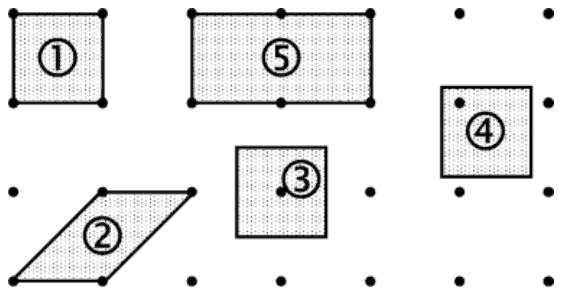
For the given unit cells of a two dimensional square lattice, which option lists all the primitive cells?
Answer: C
The primitive cells are ①, ②, ③ and ④.
A primitive cell contains exactly one lattice point and has the smallest possible area, one lattice spacing squared for this lattice; it can have any shape and need not have lattice points at its corners.
- ①, a unit square with points at its four corners, holds 4 × 1/4 = 1 point.
- ②, a parallelogram on four lattice points with the same base and height as the unit square, also has unit area and one point.
- ③ and ④ are unit squares shifted off the lattice, each enclosing exactly one lattice point inside: still one point per cell.
- ⑤ is two units long and holds 4 × 1/4 + 2 × 1/2 = 2 points, so it is a conventional (non-primitive) cell.
Options stopping at ② or ③ leave out valid primitive cells, and the option including ⑤ adds a cell of double area.
No comment is present. Be the first to comment.
Loading…
Post your comment
Please log in or register to post a comment.
Examination Categories
- SSC Exams
- Banking Exams
- Teaching Exams
- Civil Services Exams
- Railways Exams
- Engineering Recruitment Exams
- Defence Exams
- State Government Exams
- Police Exams
- Insurance Exams
- Nursing Exams
- Other Government Exams
- NRA CET
- PG Entrance Exams
- Campus Placement
- MBA Entrance Exams
- CUET and UG Entrance
- Judiciary Exams
- Regulatory Body Exams
- Software Development