
Discussion
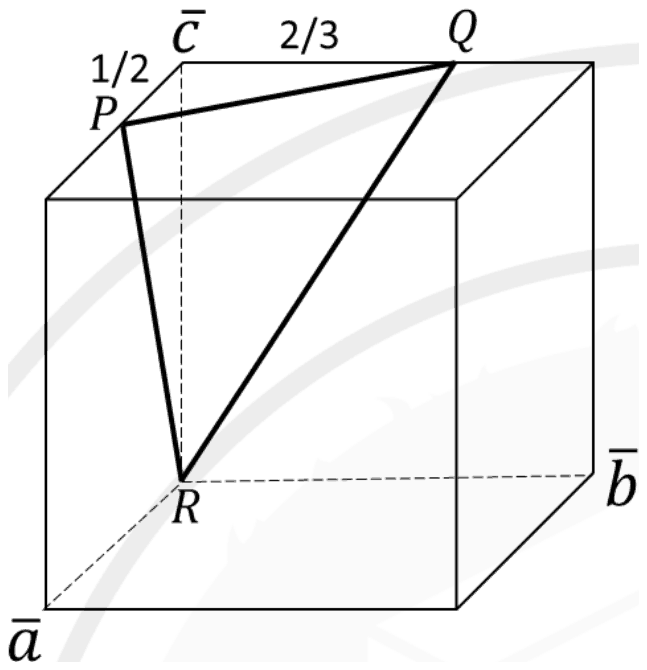
The figure below shows a plane PQR in a unit cell. The Miller indices of the plane PQR is
Answer: B
The Miller indices are \((43\bar{2})\).
Take R, where the three axes meet, as the origin, with \(a\), \(b\) and \(c\) along the axes. Then \(R = (0, 0, 0)\), \(P = (\frac{1}{2}, 0, 1)\) on the top edge along \(a\), and \(Q = (0, \frac{2}{3}, 1)\) on the top edge along \(b\). The plane passes through the origin, so its normal is the cross product of the vectors to P and Q:
\[ \begin{aligned} \vec{n} &= \left(\tfrac{1}{2}, 0, 1\right) \times \left(0, \tfrac{2}{3}, 1\right) \\ &= \left(-\tfrac{2}{3}, -\tfrac{1}{2}, \tfrac{1}{3}\right) \end{aligned} \]
Multiplying by \(-6\) clears the fractions: \((4, 3, -2)\), that is \((43\bar{2})\). Check: the plane \(4x + 3y - 2z = 0\) contains R, P (\(2 - 2 = 0\)) and Q (\(2 - 2 = 0\)).
\((432)\) misses the sign of the \(c\) index, and \((23\bar{4})\) and its negative \((\bar{2}\bar{3}4)\) swap the \(a\) and \(c\) indices: the plane \(2x + 3y - 4z = 0\) misses P, since \(1 - 4 \ne 0\).
Post your comment
Please log in or register to post a comment.
Examination Categories
- SSC Exams
- Banking Exams
- Teaching Exams
- Civil Services Exams
- Railways Exams
- Engineering Recruitment Exams
- Defence Exams
- State Government Exams
- Police Exams
- Insurance Exams
- Nursing Exams
- Other Government Exams
- NRA CET
- PG Entrance Exams
- Campus Placement
- MBA Entrance Exams
- CUET and UG Entrance
- Judiciary Exams
- Regulatory Body Exams
- Software Development