
Discussion
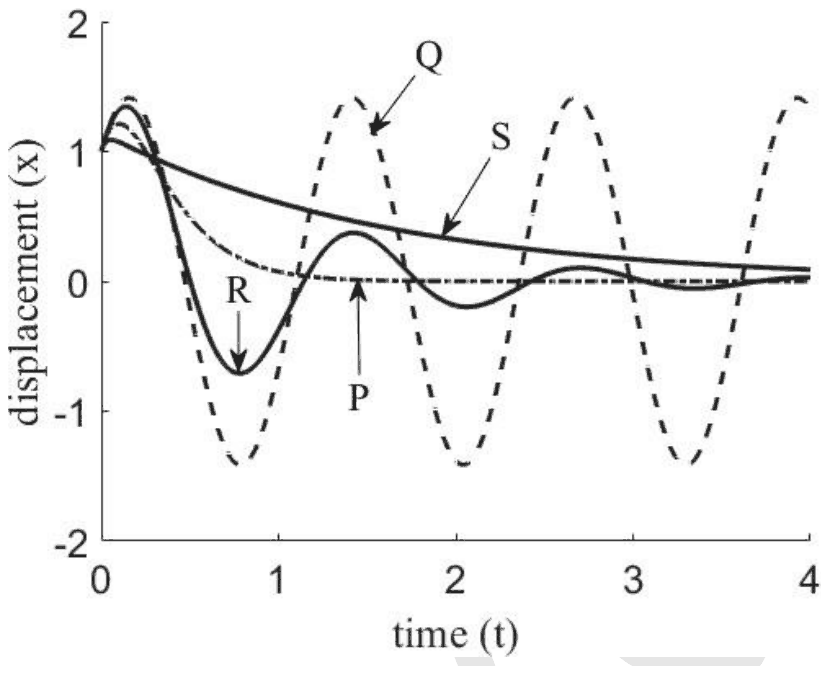
Consider the free vibration responses P, Q, R and S (shown in the figure) of a single degree of freedom spring-mass-damper system with the same initial conditions. For the different damping cases listed below, which one of the following options is correct?
1. Overdamped
2. Underdamped
3. Critically damped
4. Undamped
Answer: C
The matching is P - 3, Q - 4, R - 2, S - 1.
- Q oscillates with a constant amplitude that never decays: undamped (4).
- R oscillates about zero with a shrinking amplitude: underdamped (2).
- P returns to zero without crossing it and faster than any non-oscillating curve: critically damped (3).
- S also creeps back without oscillating, but much more slowly than P: overdamped (1).
The key distinction is between P and S. Critical damping is the smallest damping that prevents oscillation and gives the quickest non-oscillatory return; more damping than that (overdamping) only slows the return. Options that call P overdamped and S critically damped have them the wrong way round, and those that swap Q and R confuse constant with decaying oscillation.
Post your comment
Please log in or register to post a comment.
Examination Categories
- SSC Exams
- Banking Exams
- Teaching Exams
- Civil Services Exams
- Railways Exams
- Engineering Recruitment Exams
- Defence Exams
- State Government Exams
- Police Exams
- Insurance Exams
- Nursing Exams
- Other Government Exams
- NRA CET
- PG Entrance Exams
- Campus Placement
- MBA Entrance Exams
- CUET and UG Entrance
- Judiciary Exams
- Regulatory Body Exams
- Software Development