
Discussion
In a single degree of freedom underdamped spring-mass-damper system as shown in the figure, an additional damper is added in parallel such that the system still remains underdamped. Which one of the following statements is ALWAYS true?
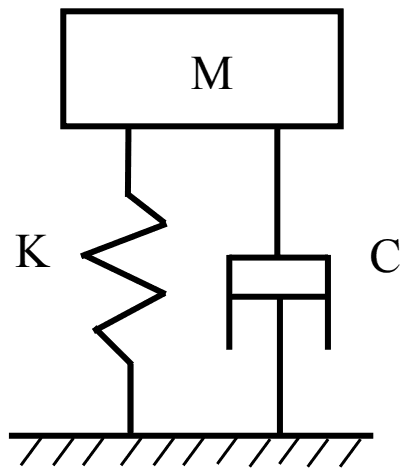
Answer: C
The statement that is always true is that the time period of free oscillations will increase.
A second damper in parallel adds to the damping coefficient, so the damping ratio ζ rises while the mass and stiffness, and hence the natural frequency ωn, are unchanged. The damped frequency is \(\omega_{d} = \omega_{n}\sqrt{1-\zeta^{2}}\), which falls as ζ rises, so the damped period \(2\pi/\omega_{d}\) gets longer. Because the system stays underdamped, it still oscillates, and this holds whatever the size of the extra damper.
Transmissibility does not change one way always: more damping lowers it for frequency ratios below √2 but raises it above √2. So neither transmissibility option is always true, and a shorter period is the opposite of the correct effect.
Post your comment
Please log in or register to post a comment.
Examination Categories
- SSC Exams
- Banking Exams
- Teaching Exams
- Civil Services Exams
- Railways Exams
- Engineering Recruitment Exams
- Defence Exams
- State Government Exams
- Police Exams
- Insurance Exams
- Nursing Exams
- Other Government Exams
- NRA CET
- PG Entrance Exams
- Campus Placement
- MBA Entrance Exams
- CUET and UG Entrance
- Judiciary Exams
- Regulatory Body Exams
- Software Development