
Discussion
Flow is taking place through a layered soil system, having two homogeneous soils M and N, as shown in the figure. The head lost in soil N is 20 times the head lost in soil M.
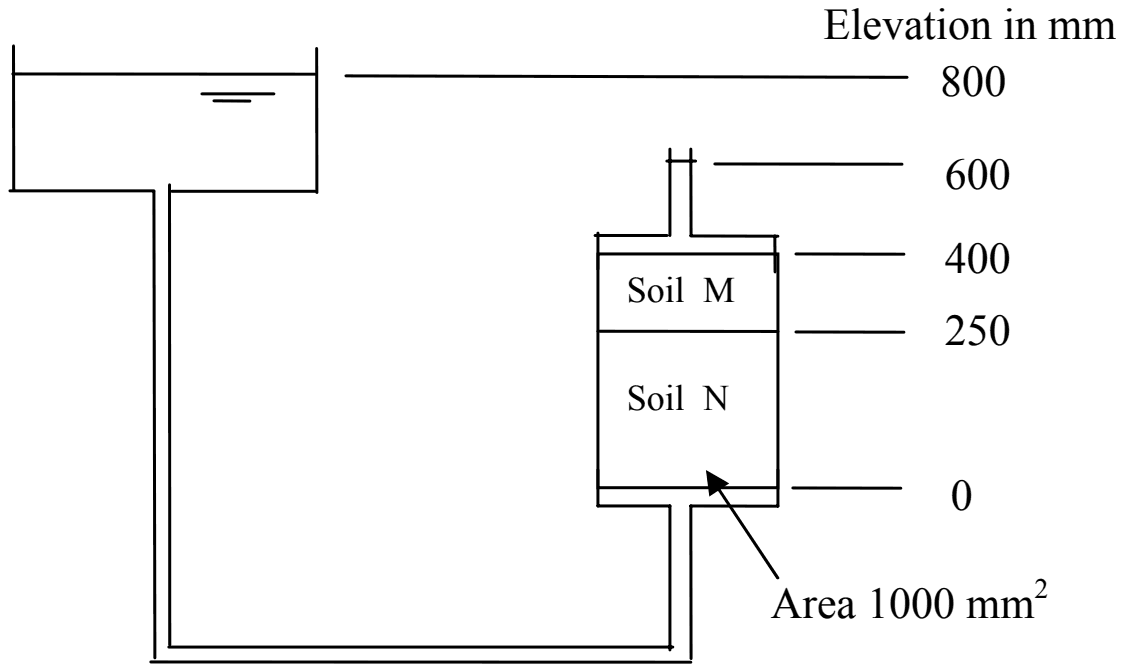
If the permeability of soil M is 3 × 10⁻⁴ mm s−1, the permeability of soil N, in mm s−1, will be
Answer: C
The permeability of soil N is \(2.5 \times 10^{-5}\) mm s−1.
The two soils are in series, so the same discharge passes through both and, with the same area, Darcy's law gives equal \(k\,h/L\) in each layer. From the elevations, soil M is 400 − 250 = 150 mm thick and soil N is 250 mm thick:
\[ \begin{aligned} k_{M}\frac{h_{M}}{L_{M}} &= k_{N}\frac{h_{N}}{L_{N}} \\ k_{N} &= k_{M}\frac{h_{M}}{h_{N}}\frac{L_{N}}{L_{M}} \\ &= 3 \times 10^{-4} \times \frac{1}{20} \times \frac{250}{150} \\ &= 2.5 \times 10^{-5} \end{aligned} \]
Ignoring the different thicknesses gives \(1.5 \times 10^{-5}\). Soil N, which loses twenty times the head, must be the less permeable layer, so values equal to or larger than \(k_{M}\) are impossible.
Post your comment
Please log in or register to post a comment.
Examination Categories
- SSC Exams
- Banking Exams
- Teaching Exams
- Civil Services Exams
- Railways Exams
- Engineering Recruitment Exams
- Defence Exams
- State Government Exams
- Police Exams
- Insurance Exams
- Nursing Exams
- Other Government Exams
- NRA CET
- PG Entrance Exams
- Campus Placement
- MBA Entrance Exams
- CUET and UG Entrance
- Judiciary Exams
- Regulatory Body Exams
- Software Development