
Discussion
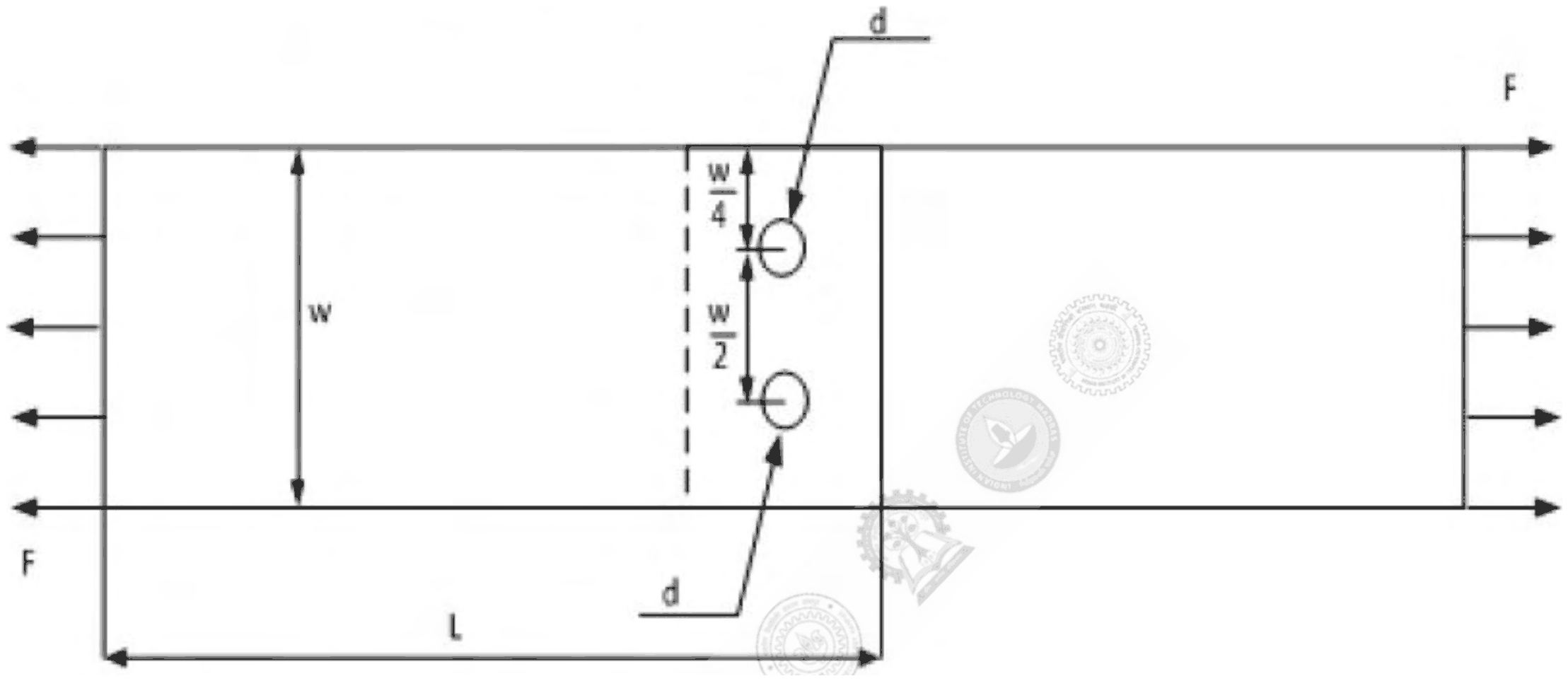
Consider the schematic of a riveted lap joint subjected to tensile load F, as shown below. Let d be the diameter of the rivets, and Sf be the maximum permissible tensile stress in the plates. What should be the minimum value for the thickness of the plates to guard against tensile failure of the plates? Assume the plates to be identical.
Answer: A
The minimum plate thickness is \(\frac{F}{S_{f}(W - 2d)}\).
The weakest tensile section of each plate is the line through the rivet holes. Two rivets of diameter d lie in that row, so the net width there is W - 2d, and the whole load F passes through it:
\[ \begin{aligned} S_{f}\,t\,(W - 2d) &\ge F \\ t &\ge \frac{F}{S_{f}(W - 2d)} \end{aligned} \]
F/(SfW) ignores the holes (the gross section). W - d removes only one hole, and 2F/(SfW) doubles the load without removing any holes.
Post your comment
Please log in or register to post a comment.
Examination Categories
- SSC Exams
- Banking Exams
- Teaching Exams
- Civil Services Exams
- Railways Exams
- Engineering Recruitment Exams
- Defence Exams
- State Government Exams
- Police Exams
- Insurance Exams
- Nursing Exams
- Other Government Exams
- NRA CET
- PG Entrance Exams
- Campus Placement
- MBA Entrance Exams
- CUET and UG Entrance
- Judiciary Exams
- Regulatory Body Exams
- Software Development