
Discussion
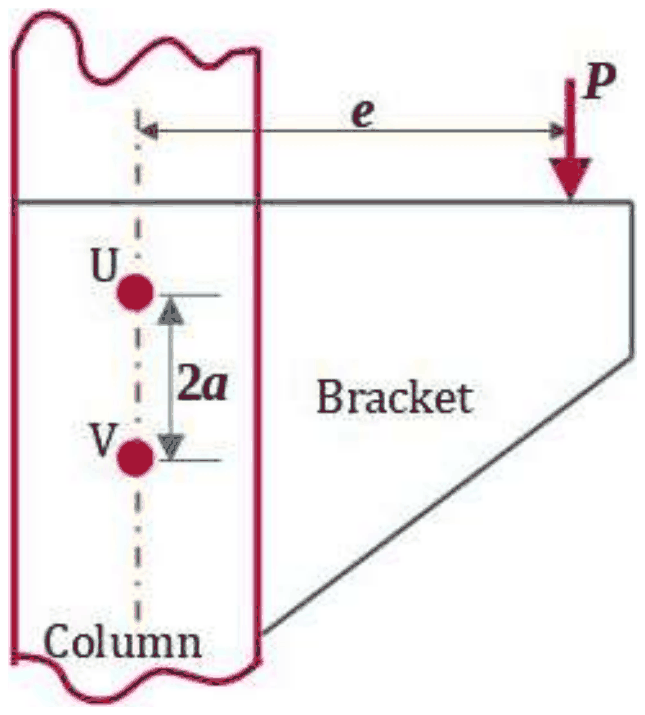
A bracket is attached to a vertical column by means of two identical rivets U and V separated by a distance of \(2a\) = 100 mm, as shown in the figure. The permissible shear stress of the rivet material is 50 MPa. If a load \(P\) = 10 kN is applied at an eccentricity \(e = 3\sqrt{7}\,a\), the minimum cross-sectional area of each of the rivets to avoid failure is ___________ mm2.
Answer: A
Each rivet needs at least 800 mm2.
The rivets are one above the other, a distance \(a = 50\) mm from their centroid. The load gives each rivet a direct shear \(P/2 = 5\) kN downwards, and the moment \(Pe\) gives each a secondary shear at right angles to the line of rivets, that is horizontal:
\[ \begin{aligned} F_{s} &= \frac{Pe\,a}{2a^{2}} = \frac{P e}{2a} = \frac{10 \times 3\sqrt{7}}{2} \\ &= 15\sqrt{7} \approx 39.7\ \text{kN} \end{aligned} \]
The two components are perpendicular, so each rivet carries
\[ \begin{aligned} F &= \sqrt{5^{2} + (15\sqrt{7})^{2}} = \sqrt{25 + 1575} = 40\ \text{kN} \\ A &= \frac{40000}{50} = 800\ \text{mm}^{2} \end{aligned} \]
200 mm2 ignores the moment, \(100\sqrt{7}\) and 25 mm2 do not follow from combining the two shears. Adding the components directly would apply only if the rivets were side by side.
Post your comment
Please log in or register to post a comment.
Examination Categories
- SSC Exams
- Banking Exams
- Teaching Exams
- Civil Services Exams
- Railways Exams
- Engineering Recruitment Exams
- Defence Exams
- State Government Exams
- Police Exams
- Insurance Exams
- Nursing Exams
- Other Government Exams
- NRA CET
- PG Entrance Exams
- Campus Placement
- MBA Entrance Exams
- CUET and UG Entrance
- Judiciary Exams
- Regulatory Body Exams
- Software Development