
Discussion
An ant walks in a straight line on a plane leaving behind a trace of its movement. The initial position of the ant is at point P facing east.
The ant first turns 72º anticlockwise at P, and then does the following two steps in sequence exactly FIVE times before halting.
1. moves forward for 10 cm.
2. turns 144º clockwise.
[Figure: a compass with North up and East to the right.]
The pattern made by the trace left behind by the ant is
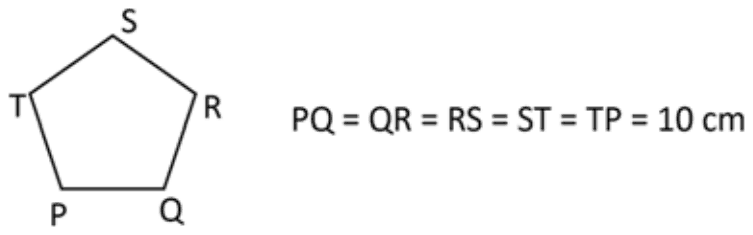
- A.
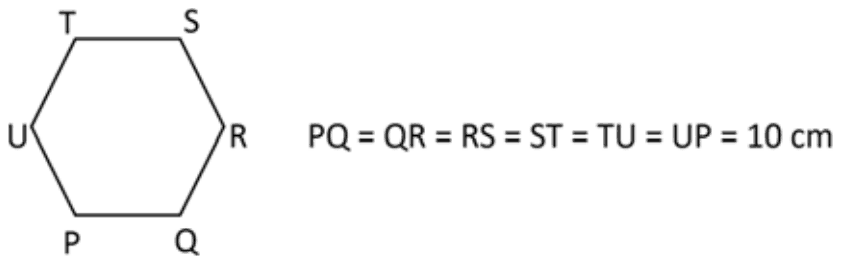
- B.
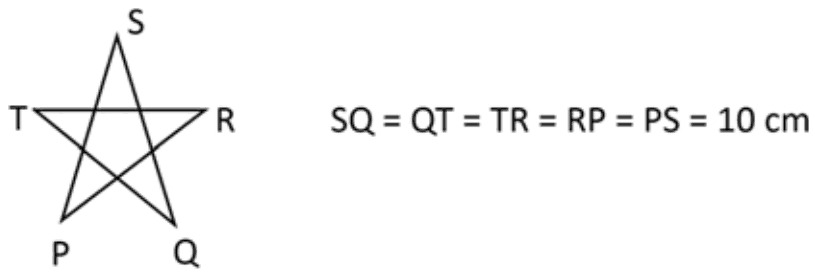
- C.
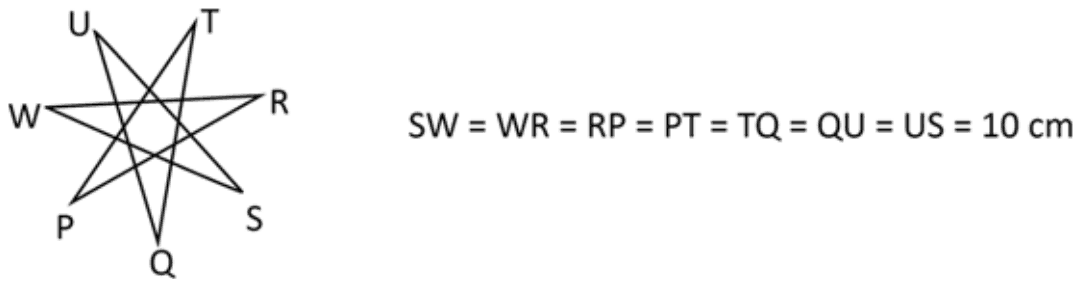
- D.
Answer: C
The trace is the five-pointed star (C).
After the first 72° turn the ant repeats 'forward 10 cm, turn 144° clockwise' five times. Turning by 144° each time means the heading changes by \(5 \times 144 = 720^{\circ}\) in total, two full turns, so the path closes after five equal segments while winding twice around its centre. A closed path of five equal segments that winds twice is a regular star pentagon (pentagram).
A regular pentagon needs turns of 72° (one full turn over five sides), and a hexagon needs six sides with 60° turns. The seven-pointed star has seven segments, but the ant makes only five moves. So only (C) fits.
Post your comment
Please log in or register to post a comment.
Examination Categories
- SSC Exams
- Banking Exams
- Teaching Exams
- Civil Services Exams
- Railways Exams
- Engineering Recruitment Exams
- Defence Exams
- State Government Exams
- Police Exams
- Insurance Exams
- Nursing Exams
- Other Government Exams
- NRA CET
- PG Entrance Exams
- Campus Placement
- MBA Entrance Exams
- CUET and UG Entrance
- Judiciary Exams
- Regulatory Body Exams
- Software Development