
Discussion
An ant walks in a straight line on a plane leaving behind a trace of its movement. The initial position of the ant is at point P facing east.
The ant first turns 72° anticlockwise at P, and then does the following two steps in sequence exactly FIVE times before halting.
1. moves forward for 10 cm.
2. turns 144° clockwise.
(A marker shows North up, East right.)
The pattern made by the trace left behind by the ant is
- A.
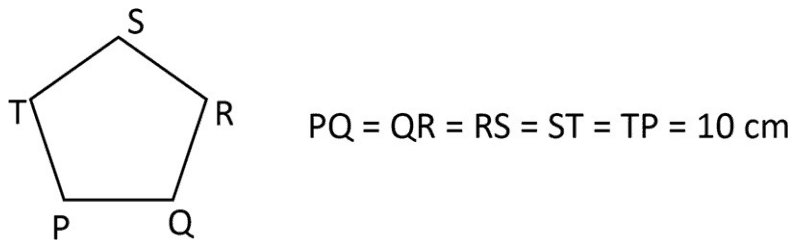
- B.
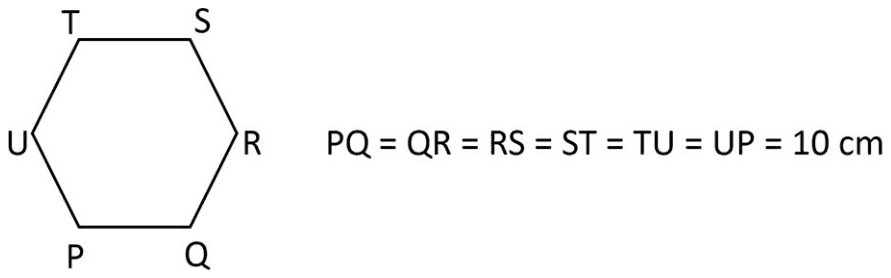
- C.
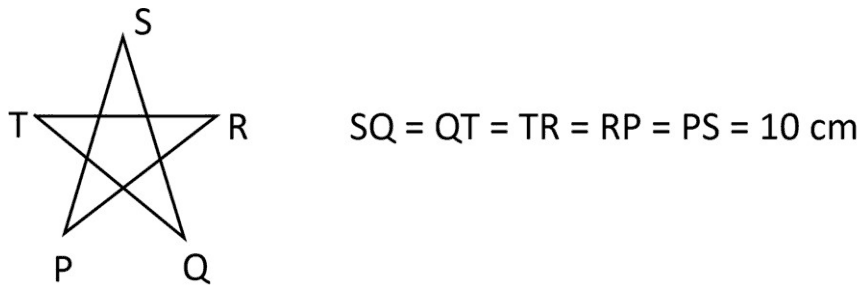
- D.
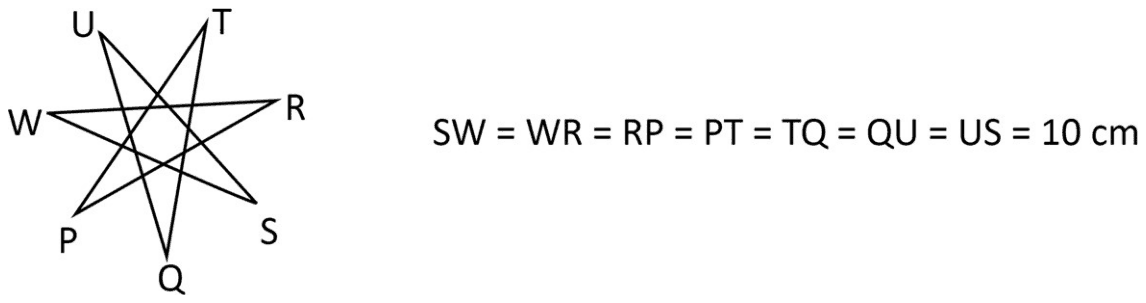
Answer: C
The trace is the five-pointed star of option (C).
After its first turn the ant heads 72° north of east. It then repeats 'move 10 cm, turn 144° clockwise' five times. Each turn changes its heading by 144°, so after five turns it has turned through 5 × 144° = 720°, exactly two full revolutions, and it is back at P facing its first direction.
A closed path of five equal strokes that turns through two full revolutions is a regular star pentagon. The angle between consecutive strokes at each point is 180° - 144° = 36°, which is the point angle of a five-pointed star.
A regular pentagon (A) would need turns of 72° each, giving one revolution in five steps. A hexagon (B) needs six strokes with 60° turns. The seven-pointed star (D) needs seven strokes, but the ant makes only five.
Post your comment
Please log in or register to post a comment.
Examination Categories
- SSC Exams
- Banking Exams
- Teaching Exams
- Civil Services Exams
- Railways Exams
- Engineering Recruitment Exams
- Defence Exams
- State Government Exams
- Police Exams
- Insurance Exams
- Nursing Exams
- Other Government Exams
- NRA CET
- PG Entrance Exams
- Campus Placement
- MBA Entrance Exams
- CUET and UG Entrance
- Judiciary Exams
- Regulatory Body Exams
- Software Development