
Discussion
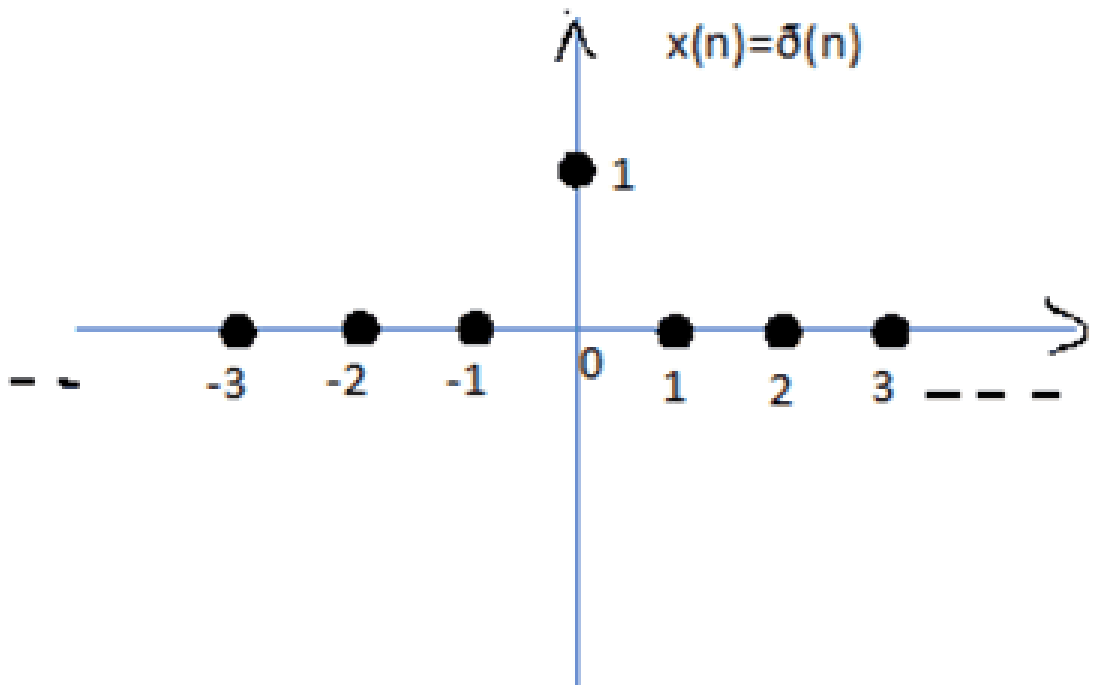
For the given signal, find its discrete time fourier transform.
Answer: B
The signal is the unit impulse \(x(n) = \delta(n)\): one at \(n = 0\) and zero everywhere else. The discrete time Fourier transform is
\[ \begin{aligned} X(e^{j\omega}) \\ &= \sum_{n=-\infty}^{\infty} x(n)e^{-j\omega n} \\ &= \delta(0)\,e^{0} = 1 \end{aligned} \]
Only the term \(n = 0\) survives, so the transform is 1 for all frequencies: the impulse contains all frequencies equally. The values 0, 2 and 3 would belong to other signals (for example, a zero signal or multiples of the impulse). The answer is 1, option B.
No comment is present. Be the first to comment.
Loading…
Post your comment
Please log in or register to post a comment.
Examination Categories
- SSC Exams
- Banking Exams
- Teaching Exams
- Civil Services Exams
- Railways Exams
- Engineering Recruitment Exams
- Defence Exams
- State Government Exams
- Police Exams
- Insurance Exams
- Nursing Exams
- Other Government Exams
- NRA CET
- PG Entrance Exams
- Campus Placement
- MBA Entrance Exams
- CUET and UG Entrance
- Judiciary Exams
- Regulatory Body Exams
- Software Development