
Discussion
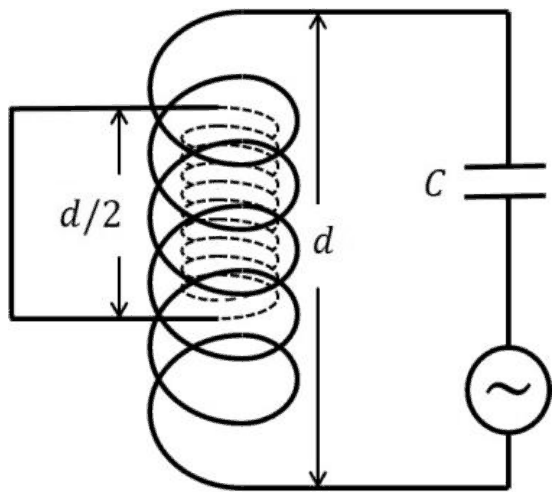
Consider a circuit consisting of a capacitor of capacitance \(C\) and a coil with \(N\) turns per unit length, cross sectional area \(S\) and length \(d\), where \(d^{2} \gg S\). There is another coil of length \(d/2\), cross sectional area \(S/2\) and \(2N\) turns per unit length completely inside the larger coil, as shown in the figure. The ends of this smaller coil are connected with each other by an insulated conducting wire. The self-inductance of the larger coil is \(L\). Neglecting edge effects and all the Ohmic resistances, the resonant frequency of the circuit is:
Answer: C
The resonant frequency is \(\frac{2}{\sqrt{3\,LC}}\).
The smaller coil is a closed loop with no resistance, so the magnetic flux through it cannot change: it carries whatever current cancels the larger coil's field inside it. With the outer field \(\mu_{0}NI\) and the inner coil's field \(\mu_{0}(2N)i\), cancellation needs \(i = -\frac{I}{2}\), and the field inside the small coil's cross-section is zero.
Now count the flux linkage of the larger coil. Half its length (\(Nd/2\) turns) surrounds the small coil, where only the area \(S - \frac{S}{2}\) carries field; the other half sees the full area \(S\):
\[ \begin{aligned} \Phi &= \tfrac{Nd}{2}\,\mu_{0}NI\tfrac{S}{2} + \tfrac{Nd}{2}\,\mu_{0}NIS \\ &= \tfrac{3}{4}\,\mu_{0}N^{2}SdI = \tfrac{3}{4}LI \end{aligned} \]
So the effective inductance is \(\frac{3L}{4}\), and
\[ \begin{aligned} \omega_{0} &= \frac{1}{\sqrt{\frac{3}{4}LC}} \\ &= \frac{2}{\sqrt{3\,LC}} \end{aligned} \]
The other options would need an effective inductance of \(\frac{15L}{16}\), \(\frac{5L}{36}\) or \(\frac{3L}{2}\); none of these follows from the shorted coil, which can only reduce the inductance, and here by exactly a quarter.
Post your comment
Please log in or register to post a comment.
Examination Categories
- SSC Exams
- Banking Exams
- Teaching Exams
- Civil Services Exams
- Railways Exams
- Engineering Recruitment Exams
- Defence Exams
- State Government Exams
- Police Exams
- Insurance Exams
- Nursing Exams
- Other Government Exams
- NRA CET
- PG Entrance Exams
- Campus Placement
- MBA Entrance Exams
- CUET and UG Entrance
- Judiciary Exams
- Regulatory Body Exams
- Software Development