
Discussion
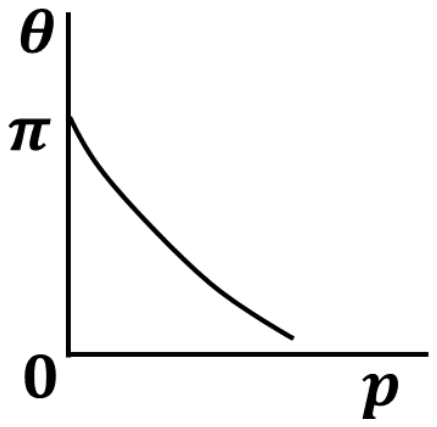
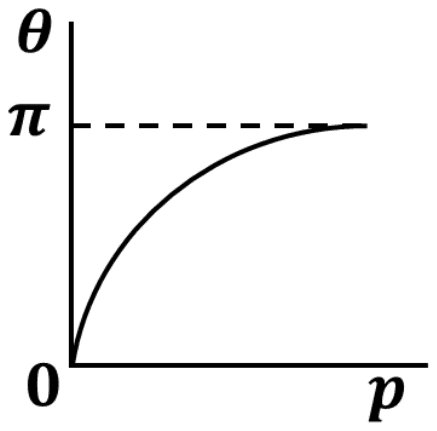
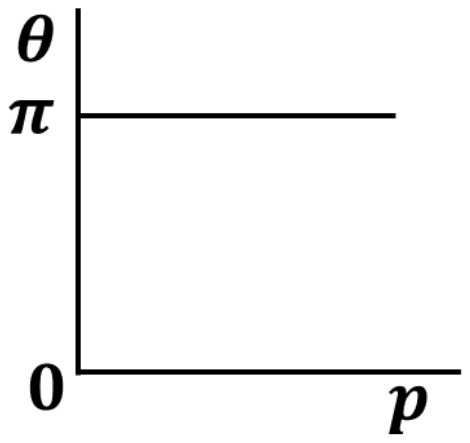
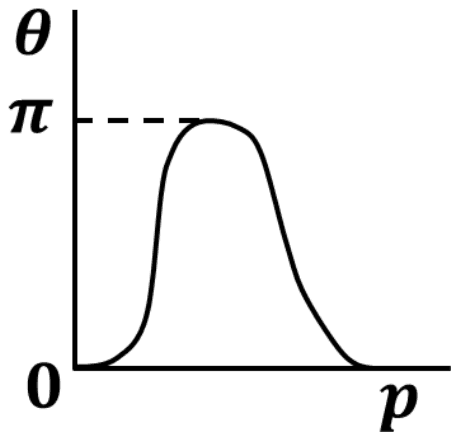
In a hadronic interaction, \(\pi^{0}\)’s are produced with different momenta, and they immediately decay into two photons with an opening angle \(\theta\) between them. Assuming that all these decays occur in one plane, which one of the following figures depicts the behaviour of \(\theta\) as a function of the \(\pi^{0}\) momentum \(p\)?
- A.
- B.
- C.
- D.
Answer: A
The opening angle falls from \(\pi\) toward zero as the momentum increases, graph (A).
In the rest frame of the \(\pi^{0}\) the two photons fly apart back to back, so for a pion at rest \(\theta = \pi\). In the laboratory a moving pion's photons are beamed forward, and the faster the pion, the smaller the angle between them. For the symmetric decay, which gives the minimum (and most probable) opening angle,
\[ \begin{aligned} \sin\frac{\theta}{2} &= \frac{m_{\pi}c^{2}}{E} \\ &= \frac{m_{\pi}c}{\sqrt{p^{2} + m_{\pi}^{2}c^{2}}} \end{aligned} \]
which equals 1 (\(\theta = \pi\)) at \(p = 0\) and tends to 0 as \(p\) grows.
Graph (B) has the trend reversed, (C) ignores relativistic beaming, and (D) starts from zero at rest, which would require the photons to be emitted in the same direction from a stationary pion, violating momentum conservation.
Post your comment
Please log in or register to post a comment.
Examination Categories
- SSC Exams
- Banking Exams
- Teaching Exams
- Civil Services Exams
- Railways Exams
- Engineering Recruitment Exams
- Defence Exams
- State Government Exams
- Police Exams
- Insurance Exams
- Nursing Exams
- Other Government Exams
- NRA CET
- PG Entrance Exams
- Campus Placement
- MBA Entrance Exams
- CUET and UG Entrance
- Judiciary Exams
- Regulatory Body Exams
- Software Development