
Discussion
The kinetics of an enzyme in the presence (+I) or absence (-I) of a reversible inhibitor is described in the following graph.
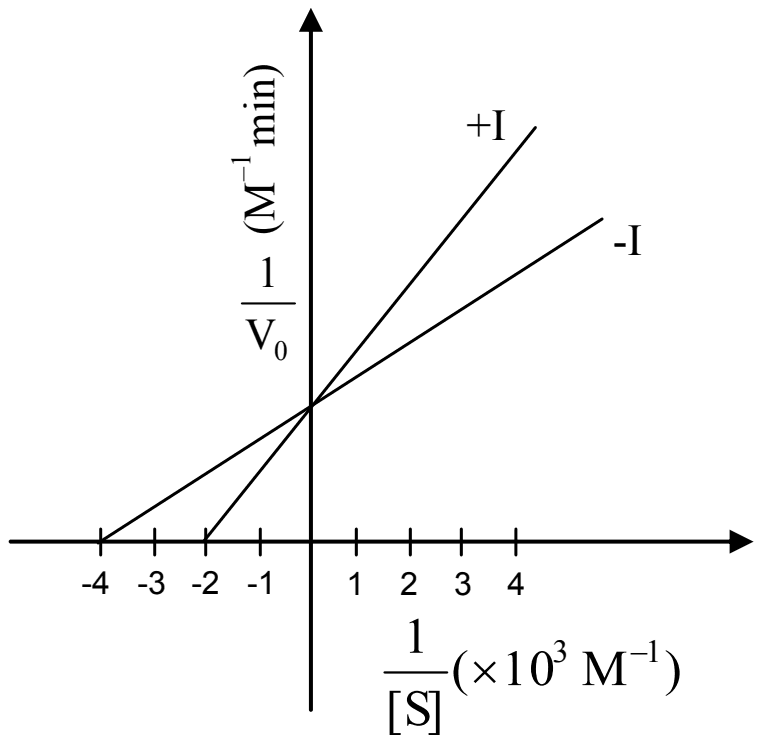
If concentration of the reversible inhibitor in +I experiment was equal to 3.0 × 10⁻³ M, then the dissociation constant for the enzyme-inhibitor complex is
Answer: C
The dissociation constant is \(3 \times 10^{-3}\) M.
Both lines meet on the 1/V0 axis, so Vmax is unchanged and the inhibition is competitive. The x intercepts give \(-1/K_{m}\):
\[ \begin{aligned} K_{m} &= \frac{1}{4 \times 10^{3}} = 0.25\ \text{mM} \\ K_{m}^{app} &= \frac{1}{2 \times 10^{3}} = 0.50\ \text{mM} \end{aligned} \]
For competitive inhibition \(K_{m}^{app} = K_{m}(1 + [I]/K_{i})\):
\[ \begin{aligned} 1 + \frac{[I]}{K_{i}} &= 2 \\ K_{i} &= [I] = 3 \times 10^{-3}\ \text{M} \end{aligned} \]
Doubling Km means the inhibitor is present at exactly its Ki. \(1.5 \times 10^{-3}\) M would correspond to a threefold increase and is not offered; the other options do not fit the twofold shift read from the graph.
Post your comment
Please log in or register to post a comment.
Examination Categories
- SSC Exams
- Banking Exams
- Teaching Exams
- Civil Services Exams
- Railways Exams
- Engineering Recruitment Exams
- Defence Exams
- State Government Exams
- Police Exams
- Insurance Exams
- Nursing Exams
- Other Government Exams
- NRA CET
- PG Entrance Exams
- Campus Placement
- MBA Entrance Exams
- CUET and UG Entrance
- Judiciary Exams
- Regulatory Body Exams
- Software Development