
Discussion
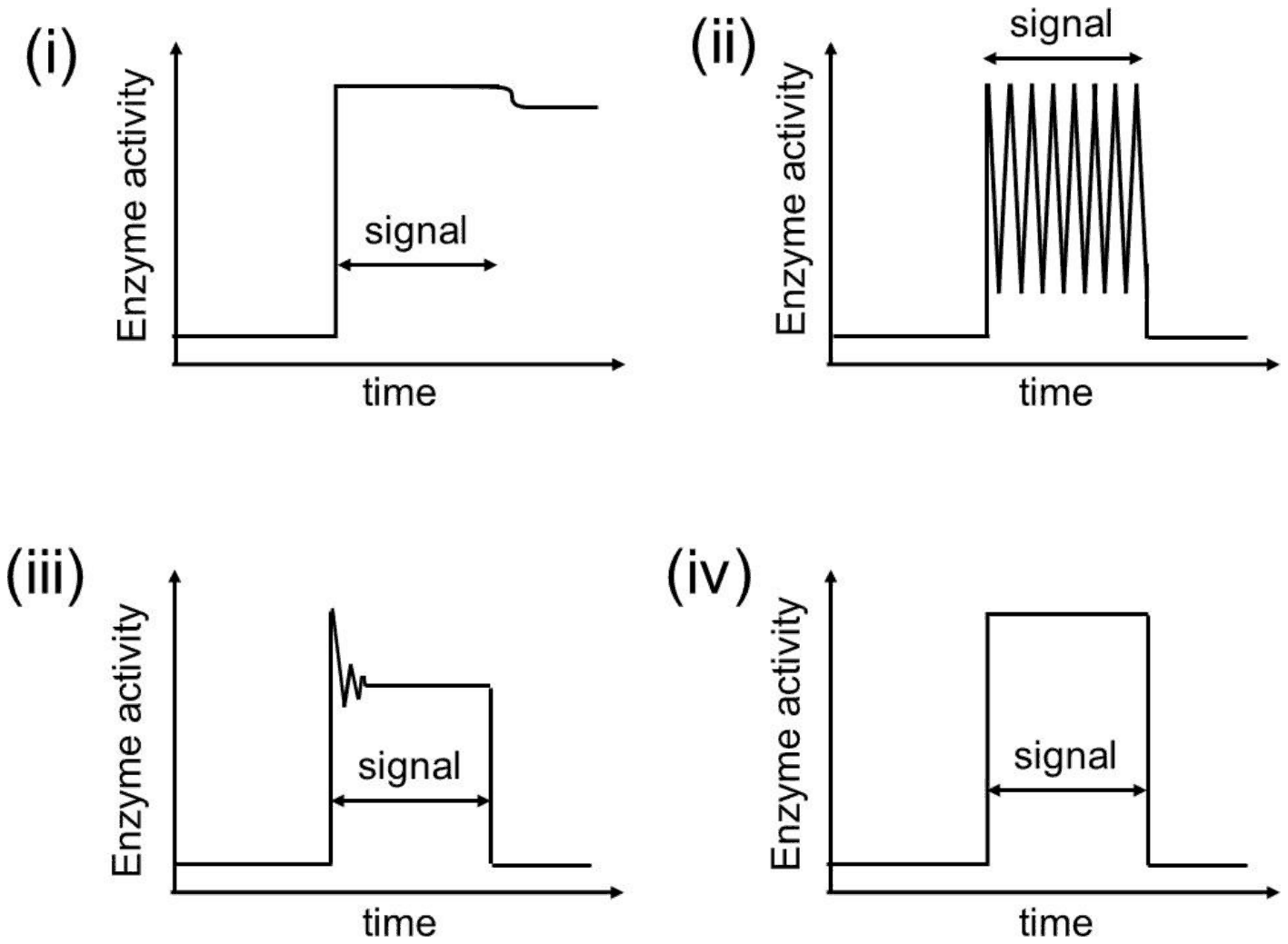
Enzyme activity profiles as a function of time in the absence or presence of different types of feedback mechanisms are shown in the figure below. Match the following feedback mechanisms with the corresponding profiles in the figure.
(p) No feedback mechanism
(q) Negative feedback mechanism with short delay
(r) Negative feedback mechanism with long delay
(s) Positive feedback mechanism
Answer: B
The match is (p)-(iv); (q)-(iii); (r)-(ii); (s)-(i).
- No feedback: activity simply follows the signal, a square pulse, profile (iv).
- Negative feedback with a short delay: the activity overshoots, the feedback quickly pulls it back, and after a few damped wiggles it settles to a steady level until the signal ends, profile (iii).
- Negative feedback with a long delay: the correction always arrives late, so the system keeps overshooting in both directions and oscillates for as long as the signal lasts, profile (ii).
- Positive feedback: the active state reinforces itself, so the activity stays high even after the signal is removed, a switch with memory, profile (i).
The other options pair the damped and sustained oscillations the wrong way round, or give the memory curve to the system with no feedback.
No comment is present. Be the first to comment.
Loading…
Post your comment
Please log in or register to post a comment.
Examination Categories
- SSC Exams
- Banking Exams
- Teaching Exams
- Civil Services Exams
- Railways Exams
- Engineering Recruitment Exams
- Defence Exams
- State Government Exams
- Police Exams
- Insurance Exams
- Nursing Exams
- Other Government Exams
- NRA CET
- PG Entrance Exams
- Campus Placement
- MBA Entrance Exams
- CUET and UG Entrance
- Judiciary Exams
- Regulatory Body Exams
- Software Development