
Discussion
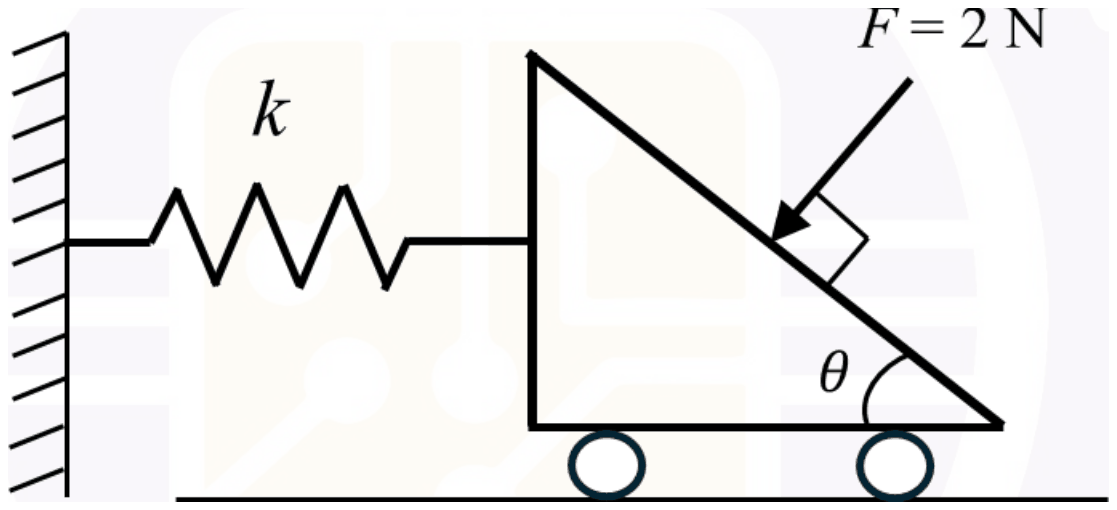
The force (F) acting on the block, as shown in the figure is 2 N. The stiffness of the spring (k) is 100 N/m.
Assume that the block is in static equilibrium and its mass is negligible.
If the static deflection of the spring \((\Delta)\) is 0.01 m, which one of the following is the corresponding angle \((\theta)\) in radians?
Answer: D
The angle is \(\theta = \frac{\pi}{6}\).
The force F is normal to the sloping face, which makes angle \(\theta\) with the horizontal base, so F makes the same angle \(\theta\) with the vertical. Its horizontal component pushes the block towards the wall and is resisted by the spring; the vertical component is taken by the floor.
\[ \begin{aligned} F\sin\theta &= k\Delta = 100 \times 0.01 = 1\ \text{N} \\ \sin\theta &= \frac{1}{2},\ \theta = \frac{\pi}{6} \end{aligned} \]
Using the cosine instead of the sine gives \(\pi/3\), the complementary angle. \(\pi/4\) and \(\pi/5\) give horizontal components of 1.41 N and 1.18 N, which do not match the spring force of 1 N.
Post your comment
Please log in or register to post a comment.
Examination Categories
- SSC Exams
- Banking Exams
- Teaching Exams
- Civil Services Exams
- Railways Exams
- Engineering Recruitment Exams
- Defence Exams
- State Government Exams
- Police Exams
- Insurance Exams
- Nursing Exams
- Other Government Exams
- NRA CET
- PG Entrance Exams
- Campus Placement
- MBA Entrance Exams
- CUET and UG Entrance
- Judiciary Exams
- Regulatory Body Exams
- Software Development