
Discussion
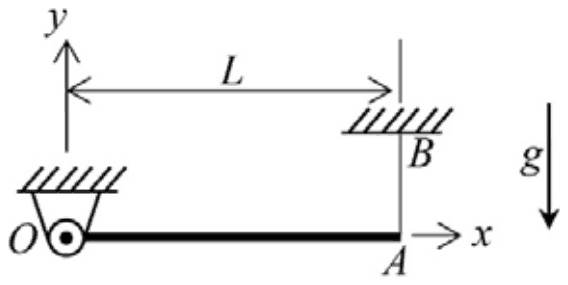
One end of a uniform rigid rod \(OA\) of length \(L\) and mass \(m\) is attached to a frictionless hinge at \(O\). The other end of the rod is connected to the roof at \(B\) with a mass-less inextensible thread \(AB\). Initially the rod is horizontal and at rest. The gravity is acting vertically downward as shown. Immediately after the thread \(AB\) is cut, the reaction on the rod at \(O\) is
Answer: A
The reaction is \(\frac{mg}{4}\) in the positive y-direction.
Just after the cut the rod is still at rest, so only the angular acceleration about O matters. Taking moments about the hinge:
\[ \begin{aligned} \frac{mL^{2}}{3}\alpha &= mg\frac{L}{2},\quad \alpha = \frac{3g}{2L} \\ a_{G} &= \alpha\frac{L}{2} = \frac{3g}{4}\ \text{(downward)} \end{aligned} \]
Newton's law for the vertical motion of the centre of mass gives \(mg - R = m\cdot 3g/4\), so \(R = mg/4\), upward. mg would be the static reaction with no thread, and the downward options have the wrong sense: the hinge must still support part of the weight.
Post your comment
Please log in or register to post a comment.
Examination Categories
- SSC Exams
- Banking Exams
- Teaching Exams
- Civil Services Exams
- Railways Exams
- Engineering Recruitment Exams
- Defence Exams
- State Government Exams
- Police Exams
- Insurance Exams
- Nursing Exams
- Other Government Exams
- NRA CET
- PG Entrance Exams
- Campus Placement
- MBA Entrance Exams
- CUET and UG Entrance
- Judiciary Exams
- Regulatory Body Exams
- Software Development