
Discussion
The frame shown in the figure is loaded at S with a force of 2000 N. The reactions at T are denoted by Tx and Ty, while the reaction at W is Wy. Neglect the weight of the members.
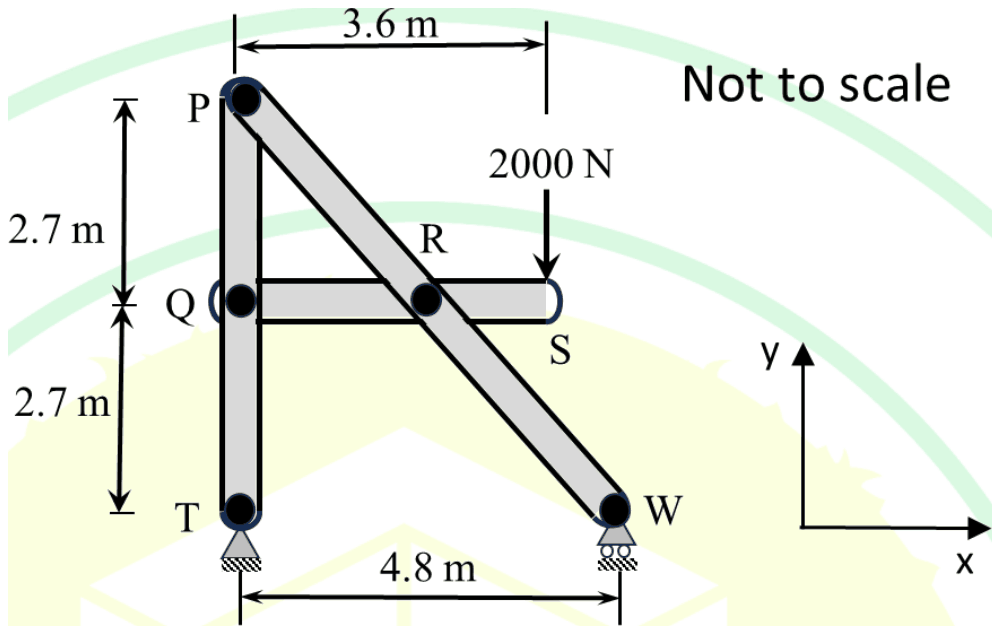
Which one of the following options for the magnitudes of the forces (in N), Tx, Ty and Wy, is CORRECT?
Answer: D
The reactions are \(T_{x} = 0\), \(T_{y} = 500\) N and \(W_{y} = 1500\) N.
Treat the whole frame as one free body. W is a roller, so it gives only a vertical reaction; the only other horizontal force could come from the pin at T, and there is no horizontal load, so \(T_{x} = 0\).
Take moments about T. The 2000 N load at S acts 3.6 m to the right of the line PT, and W is 4.8 m from T:
\[ \begin{aligned} W_{y} \times 4.8 &= 2000 \times 3.6 \Rightarrow W_{y} = 1500\ \text{N} \\ T_{y} &= 2000 - 1500 = 500\ \text{N} \end{aligned} \]
The internal pins at P, Q and R do not affect the support reactions of the frame as a whole. Equal shares of 1000 N would need the load midway between T and W (2.4 m), and the 1500/500 split the other way round puts the load nearer T than it is.
Post your comment
Please log in or register to post a comment.
Examination Categories
- SSC Exams
- Banking Exams
- Teaching Exams
- Civil Services Exams
- Railways Exams
- Engineering Recruitment Exams
- Defence Exams
- State Government Exams
- Police Exams
- Insurance Exams
- Nursing Exams
- Other Government Exams
- NRA CET
- PG Entrance Exams
- Campus Placement
- MBA Entrance Exams
- CUET and UG Entrance
- Judiciary Exams
- Regulatory Body Exams
- Software Development