
Discussion
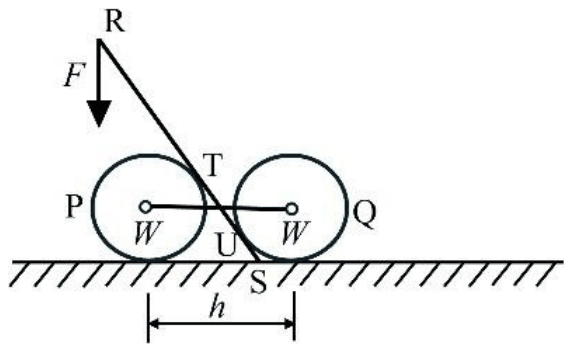
Two smooth drums each weighing \(W\) and radius, \(r\) are connected by a stiff rope of length, \(h\) as shown in the figure. Force \(F\) is applied using a massless lever (RS) of length, \(l\). The friction between the drums and the lever (RS) is negligible. The system is in static equilibrium.
Which one of the following represents the CORRECT free body diagram of the lever (RS)?
Figures are not to scale. \(N_1\), \(N_2\), and \(N_3\) in the options are reaction forces and \(F_f\) is the frictional force.
- A.
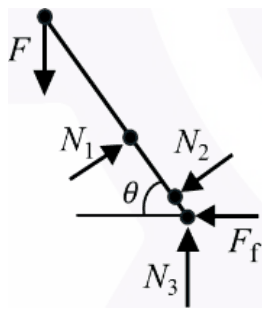
- B.
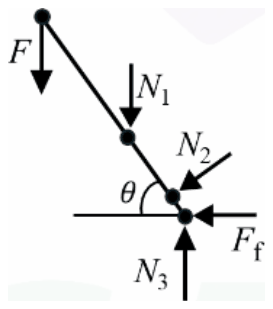
- C.
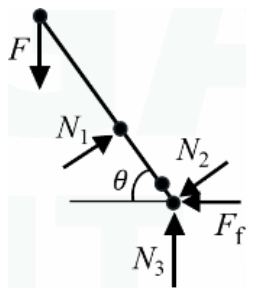
- D.
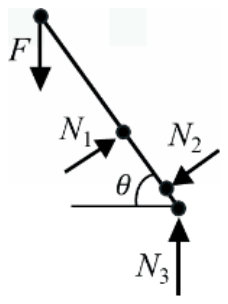
Answer: A
The correct free body diagram of the lever is (A), as the key states.
The lever RS carries the applied force \(F\) downward at R. It rests against the left drum at T and against the right drum at U, and its foot S stands on the ground. The drums are smooth and the lever-drum friction is negligible, so each drum can push on the lever only perpendicular to it. The lever lies on the upper-right side of the left drum's centre, so at T the drum pushes the lever up and to the right (\(N_{1}\), perpendicular to the lever). The lever lies on the lower-left side of the right drum's centre, so at U that drum pushes the lever down and to the left (\(N_{2}\), also perpendicular). At S the ground gives a vertical reaction \(N_{3}\) and a horizontal friction force \(F_{f}\), because the problem makes only the drum-lever friction negligible and the unequal pushes at T and U have a horizontal component to be balanced.
(B) draws \(N_{1}\) vertical, but a smooth contact force must be perpendicular to the lever. (C) applies \(N_{2}\) at the foot S instead of at the contact point U. (D) leaves out the friction force at S. Only (A) has \(N_{1}\) at T and \(N_{2}\) at U perpendicular to the lever, with both \(N_{3}\) and \(F_{f}\) at S. The choice among the diagrams follows the printed arrows; I read them on the page image and did not find a published solution to compare against.
Post your comment
Please log in or register to post a comment.
Examination Categories
- SSC Exams
- Banking Exams
- Teaching Exams
- Civil Services Exams
- Railways Exams
- Engineering Recruitment Exams
- Defence Exams
- State Government Exams
- Police Exams
- Insurance Exams
- Nursing Exams
- Other Government Exams
- NRA CET
- PG Entrance Exams
- Campus Placement
- MBA Entrance Exams
- CUET and UG Entrance
- Judiciary Exams
- Regulatory Body Exams
- Software Development