
Discussion
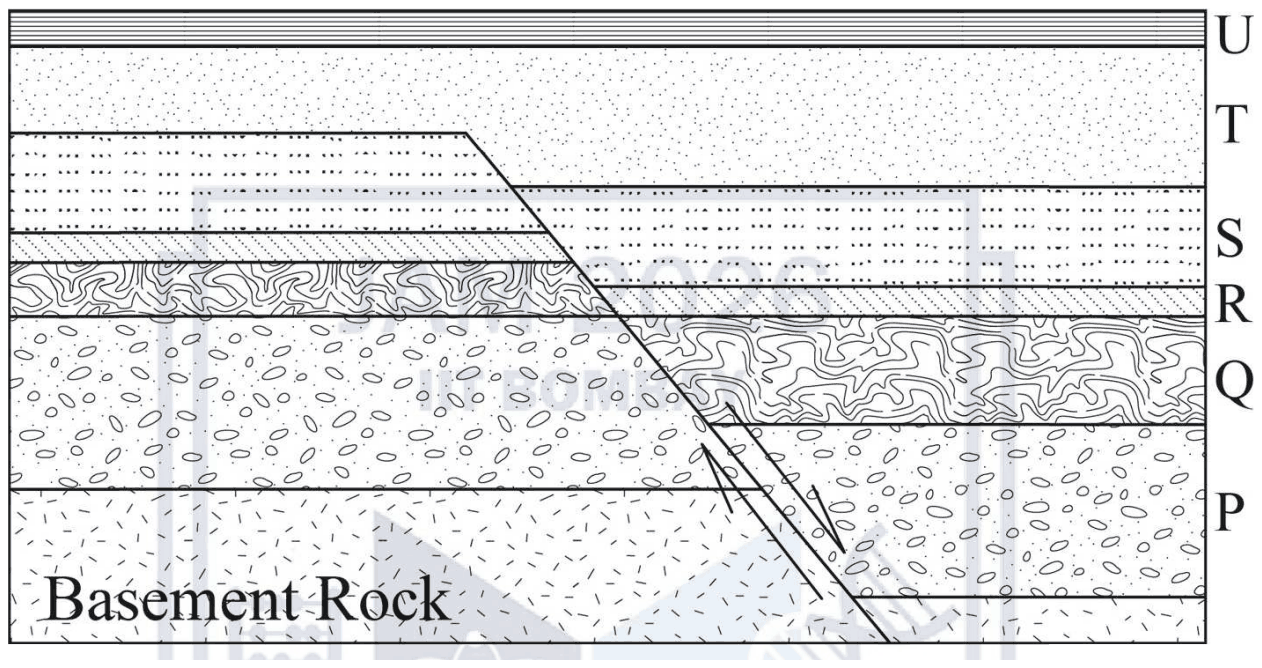
The schematic shows a geological cross-section of a faulted region of sedimentary rocks (beds P to U). Assuming continuous sedimentation, select the beds that record the earliest activation and the latest reactivation of the fault.
Answer: A
The beds that record the earliest activation and the latest reactivation are Q and T.
A fault that moves while sediment is being laid down (a growth fault) leaves a tell-tale signature: a bed deposited during movement is thicker on the downthrown block, because the sea floor there is lower and takes more sediment, while a bed deposited when the fault is quiet has the same thickness on both sides. The fault here dips to the right and the right-hand block is the downthrown one.
Bed P, the lowest in the sequence, has the same thickness on both sides and is simply offset, so it was laid down before the fault moved. Bed Q is the first bed that is clearly thicker on the downthrown side, so it records the earliest activation. Beds R and S are of equal thickness on both sides, which means the fault was inactive while they were deposited. Bed T is thicker on the downthrown block again, which marks a later reactivation, and the fault tip dies out inside T. Bed U covers the fault and is of uniform thickness, so the movement had stopped by then.
The other options pair Q or T with a bed that does not change thickness (P, R) or with the sealing bed U, so they are wrong.
Post your comment
Please log in or register to post a comment.
Examination Categories
- SSC Exams
- Banking Exams
- Teaching Exams
- Civil Services Exams
- Railways Exams
- Engineering Recruitment Exams
- Defence Exams
- State Government Exams
- Police Exams
- Insurance Exams
- Nursing Exams
- Other Government Exams
- NRA CET
- PG Entrance Exams
- Campus Placement
- MBA Entrance Exams
- CUET and UG Entrance
- Judiciary Exams
- Regulatory Body Exams
- Software Development