
Discussion
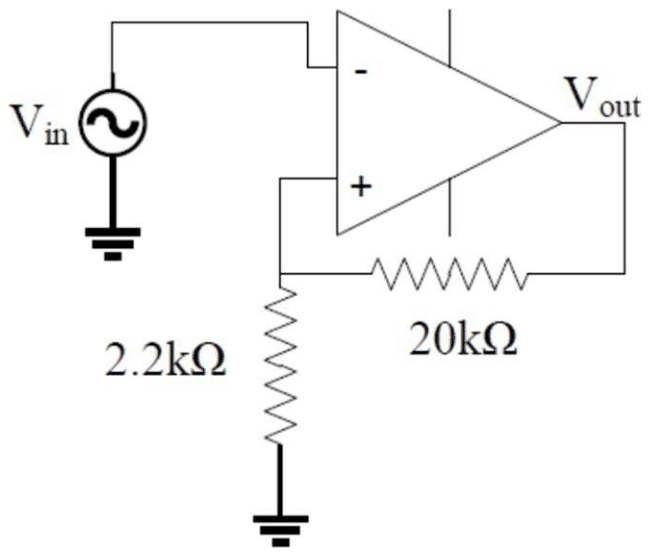
For the Op-Amp circuit shown below, choose the correct output waveform corresponding to the input \(V_{in} = 1.5\sin 20\pi t\) (in Volts). The saturation voltage for this circuit is \(V_{sat} = \pm 10\) V.
Answer: A
The output is (A), a square wave switching between +10 V and −10 V.
The input goes to the inverting terminal and the output is fed back to the non-inverting terminal through the 20 kΩ/2.2 kΩ divider. That is positive feedback, so the circuit is an inverting Schmitt trigger: the output sits at +10 V or −10 V. The switching thresholds are the fed-back fraction of the output:
\[ \begin{aligned} V_{T} &= \pm 10 \times \frac{2.2}{2.2 + 20} \\ &\approx \pm 0.99\ \text{V} \end{aligned} \]
The 1.5 V peak input crosses both thresholds every cycle, so the output flips between the two saturation levels at the input frequency (10 Hz), producing a square wave.
A constant +10 V would mean the input never reached the threshold, which it does. A sine of amplitude 10 would need linear negative feedback, and 0 V would need no gain at all.
Post your comment
Please log in or register to post a comment.
Examination Categories
- SSC Exams
- Banking Exams
- Teaching Exams
- Civil Services Exams
- Railways Exams
- Engineering Recruitment Exams
- Defence Exams
- State Government Exams
- Police Exams
- Insurance Exams
- Nursing Exams
- Other Government Exams
- NRA CET
- PG Entrance Exams
- Campus Placement
- MBA Entrance Exams
- CUET and UG Entrance
- Judiciary Exams
- Regulatory Body Exams
- Software Development