
Discussion
In the circuit shown, V(t) = 2 \(sin(2000\pi t)\) Volts, where t is in seconds, which of the following options is correct?
(take the opamp to be ideal)
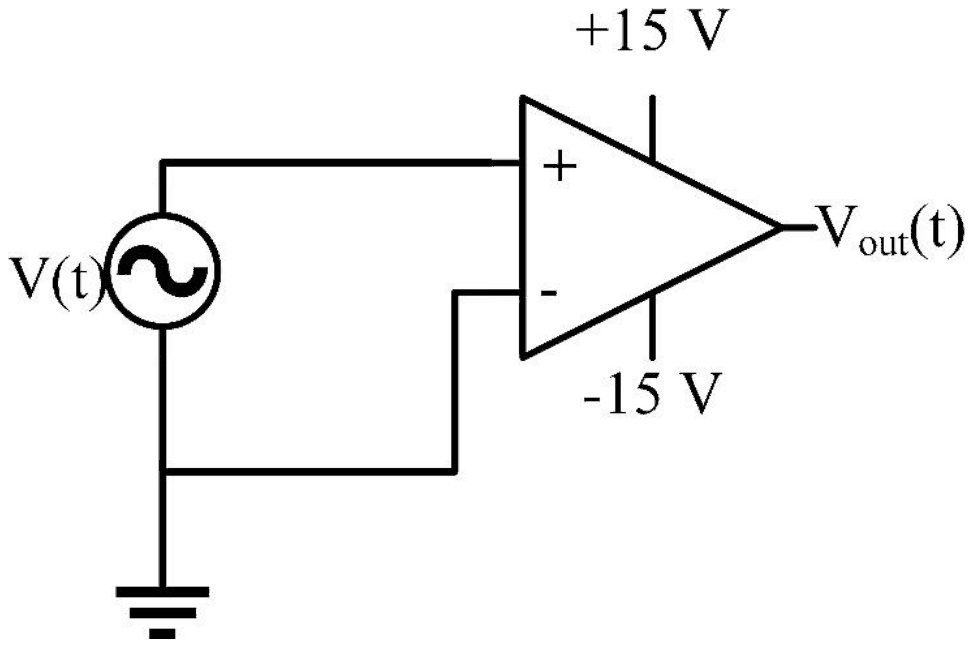
Answer: A
\(V_{out}\) is a square wave of 30 V peak-to-peak with a period of 1 ms.
With no feedback, an ideal op-amp has infinite open-loop gain, so it acts as a comparator: the output sits at the positive rail, +15 V, whenever the non-inverting input is above the inverting input (here, ground), and at −15 V whenever it is below. The sine input crosses zero twice per cycle, so the output switches between +15 V and −15 V, a square wave of 30 V peak-to-peak.
The input \(2\sin(2000\pi t)\) has \(\omega = 2000\pi\), so f = 1000 Hz and the period is 1 ms; the square wave has the same period. A 4 V peak-to-peak output would mean unity gain (a follower), which needs negative feedback, and a 30 V sine wave would need a finite gain of 7.5.
Post your comment
Please log in or register to post a comment.
Examination Categories
- SSC Exams
- Banking Exams
- Teaching Exams
- Civil Services Exams
- Railways Exams
- Engineering Recruitment Exams
- Defence Exams
- State Government Exams
- Police Exams
- Insurance Exams
- Nursing Exams
- Other Government Exams
- NRA CET
- PG Entrance Exams
- Campus Placement
- MBA Entrance Exams
- CUET and UG Entrance
- Judiciary Exams
- Regulatory Body Exams
- Software Development