
Discussion
Which one of the following curves correctly represents (schematically) the solution for the equation \(\frac{df}{dx} + 2f = 3;\ f(0) = 0\)?
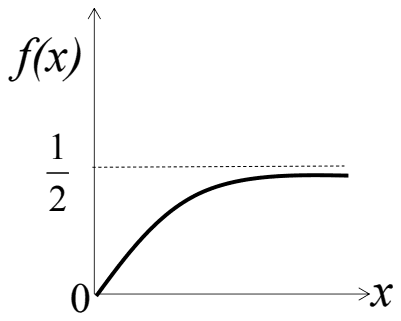
- A.
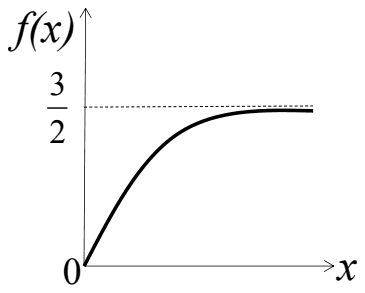
- B.
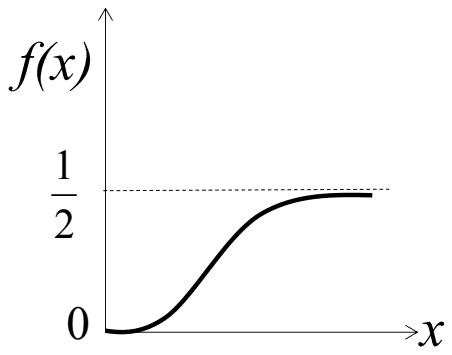
- C.
- D.
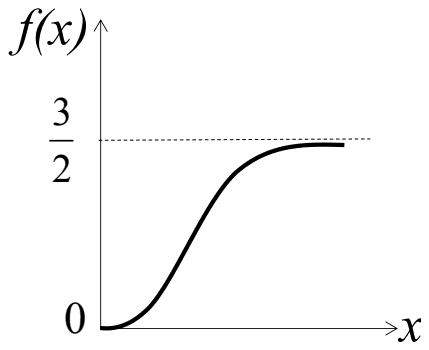
Answer: B
The correct curve is (B).
Solve the linear equation with the integrating factor \(e^{2x}\):
\[ \begin{aligned} f(x) &= \tfrac{3}{2} + Ce^{-2x}, \quad f(0) = 0 \\ f(x) &= \tfrac{3}{2}\left(1 - e^{-2x}\right) \end{aligned} \]
The curve starts at 0 with slope \(f'(0) = 3\), not zero, and rises steadily (always concave down) towards \(\frac{3}{2}\). That is graph (B).
Graphs (A) and (C) level off at \(\frac{1}{2}\), the wrong limit. Graphs (C) and (D) start flat with an S-shape, which would need \(f'(0) = 0\), but the equation gives \(f'(0) = 3 - 2f(0) = 3\).
No comment is present. Be the first to comment.
Loading…
Post your comment
Please log in or register to post a comment.
Examination Categories
- SSC Exams
- Banking Exams
- Teaching Exams
- Civil Services Exams
- Railways Exams
- Engineering Recruitment Exams
- Defence Exams
- State Government Exams
- Police Exams
- Insurance Exams
- Nursing Exams
- Other Government Exams
- NRA CET
- PG Entrance Exams
- Campus Placement
- MBA Entrance Exams
- CUET and UG Entrance
- Judiciary Exams
- Regulatory Body Exams
- Software Development