
Discussion
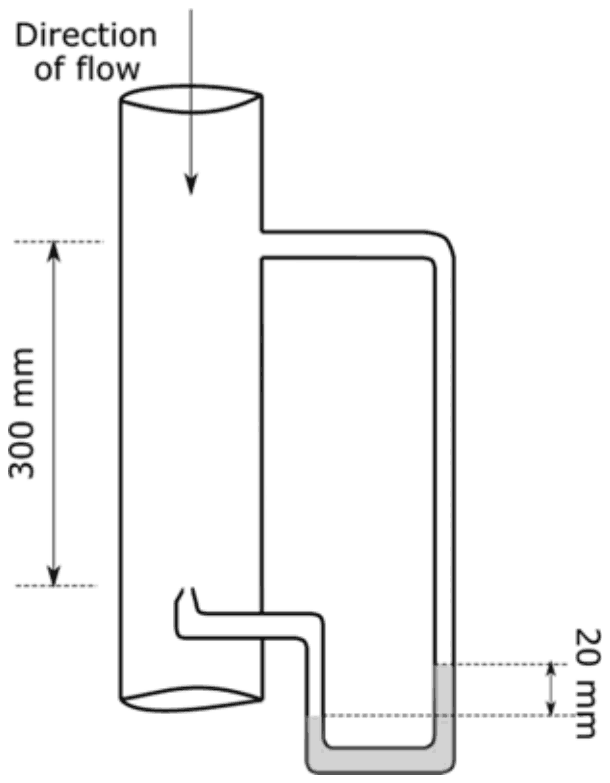
Consider an inviscid flow through a smooth pipe which has a pitot-static tube arrangement as shown. Find the centre-line velocity in the pipe.
Consider that the density of the fluid is 1000 kg/m3, acceleration due to gravity is 10 m/s2, and the specific gravity of the manometric fluid is 11.
Answer: A
The centre-line velocity is 2 m/s.
The pitot tube reads the stagnation pressure and the static tap the static pressure. In the manometer the difference in piezometric head shows up as the 20 mm deflection of the manometric fluid; the 300 mm vertical spacing between the two openings is accounted for by the fluid columns in the connecting lines and does not appear in the result. So
\[ \begin{aligned} \frac{1}{2}\rho V^{2} &= (\rho_{m} - \rho) g h \\ &= (11000 - 1000)(10)(0.02) = 2000\ \text{Pa} \\ V &= \sqrt{\frac{2 \times 2000}{1000}} = 2\ \text{m/s} \end{aligned} \]
Using the full manometric density 11000 instead of the difference gives about 2.1 m/s, and 3, 5 and 7 m/s do not follow from a 20 mm reading with these densities.
Post your comment
Please log in or register to post a comment.
Examination Categories
- SSC Exams
- Banking Exams
- Teaching Exams
- Civil Services Exams
- Railways Exams
- Engineering Recruitment Exams
- Defence Exams
- State Government Exams
- Police Exams
- Insurance Exams
- Nursing Exams
- Other Government Exams
- NRA CET
- PG Entrance Exams
- Campus Placement
- MBA Entrance Exams
- CUET and UG Entrance
- Judiciary Exams
- Regulatory Body Exams
- Software Development