
Discussion
Group-I shows different two-dimensional bodies and Group-II mentions their total drag coefficient \((C_{D})\) based on frontal area while facing parallel flow of fluid having Reynolds number \(Re \ge 10^{4}\) along the direction of arrow. The bodies are placed symmetrically with respect to the flow direction.
Group-I:
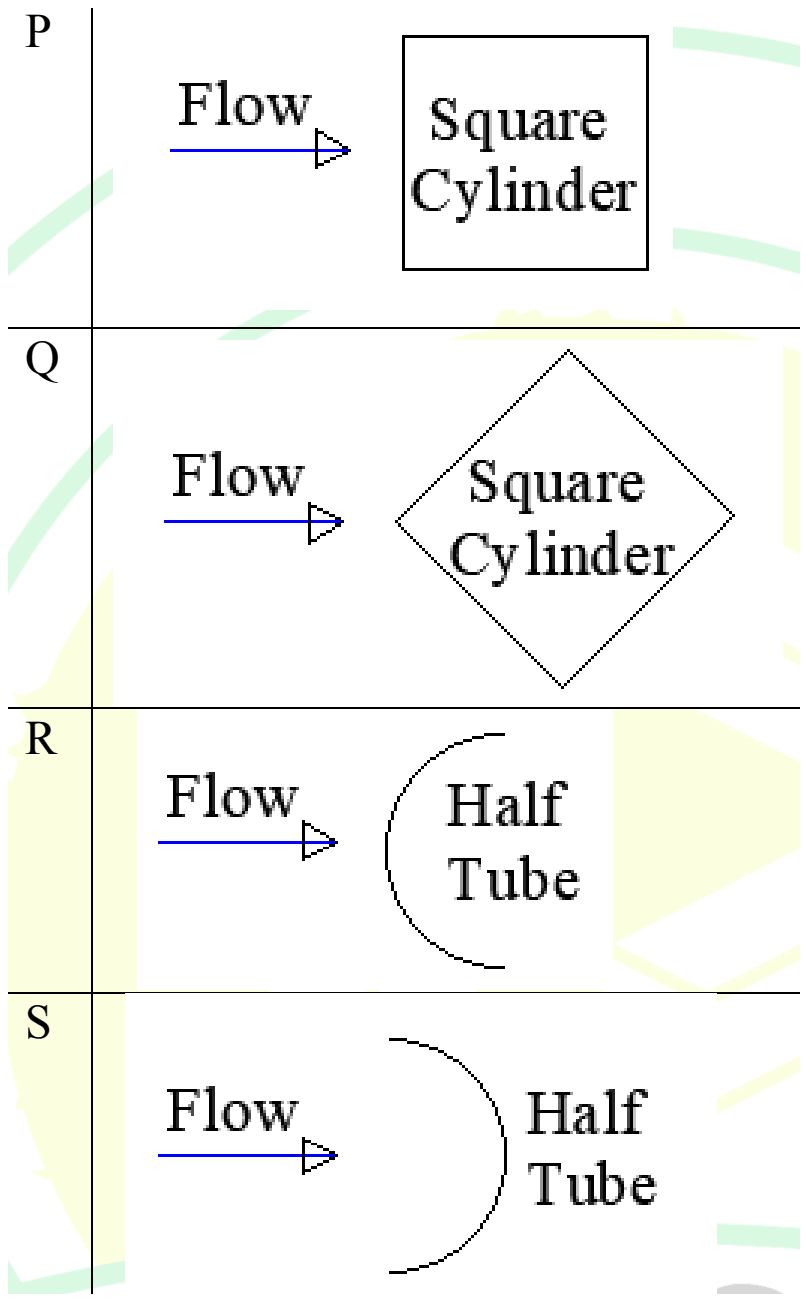
Group-II: 1. 1.2 2. 1.6 3. 2.1 4. 2.3
Which one of the following options identifies the correct match between Group-I and Group-II, as per the concept of degree of streamlining?
Answer: A
The match is P-3, Q-2, R-1, S-4.
At high Reynolds number drag on bluff bodies is mostly pressure drag, set by how abruptly the flow separates. The more streamlined the face toward the flow, the lower the drag coefficient.
- R, the half tube with its convex side to the flow, is the most streamlined: \(C_{D} \approx 1.2\).
- Q, the square cylinder with a corner to the flow, splits the flow gradually: \(C_{D} \approx 1.6\).
- P, the square cylinder with a flat face to the flow, separates at sharp corners: \(C_{D} \approx 2.1\).
- S, the half tube with its concave side to the flow, traps the flow like a cup: \(C_{D} \approx 2.3\), the highest.
Options putting the concave half tube at 1.2 (S-1) or the convex half tube at 1.6 or 2.3 reverse the effect of streamlining.
Post your comment
Please log in or register to post a comment.
Examination Categories
- SSC Exams
- Banking Exams
- Teaching Exams
- Civil Services Exams
- Railways Exams
- Engineering Recruitment Exams
- Defence Exams
- State Government Exams
- Police Exams
- Insurance Exams
- Nursing Exams
- Other Government Exams
- NRA CET
- PG Entrance Exams
- Campus Placement
- MBA Entrance Exams
- CUET and UG Entrance
- Judiciary Exams
- Regulatory Body Exams
- Software Development