
Discussion
Air flows at the rate of 1.5 m3/s through a horizontal pipe with a gradually reducing cross-section as shown in the figure. The two cross-sections of the pipe have diameters of 400 mm and 200 mm. Take the air density as 1.2 kg/m3 and assume inviscid incompressible flow. The change in pressure (p2 − p1) (in kPa) between sections 1 and 2 is
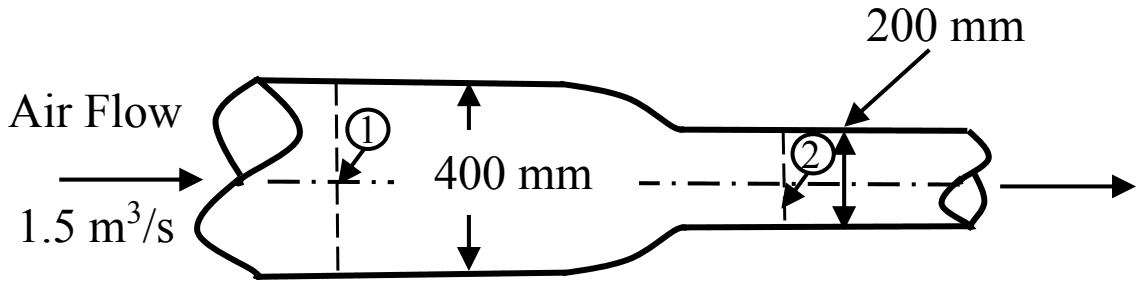
Answer: A
The pressure change is -1.28 kPa.
Continuity gives the velocities from Q = 1.5 m3/s:
\[ \begin{aligned} V_{1} &= \frac{1.5}{\pi(0.2)^{2}} = 11.94\ \text{m/s} \\ V_{2} &= \frac{1.5}{\pi(0.1)^{2}} = 47.75\ \text{m/s} \end{aligned} \]
Bernoulli's equation for a horizontal pipe then gives
\[ \begin{aligned} p_{2} - p_{1} &= \frac{\rho}{2}\left(V_{1}^{2} - V_{2}^{2}\right) \\ &= 0.6\,(142.5 - 2280.0) \\ &= -1282\ \text{Pa} \approx -1.28\ \text{kPa} \end{aligned} \]
The pressure falls as the flow speeds up in the narrower section, so the change is negative; +1.28 has the sign reversed. 2.56 doubles the result by dropping the 1/2, and -2.13 does not follow from these data.
Post your comment
Please log in or register to post a comment.
Examination Categories
- SSC Exams
- Banking Exams
- Teaching Exams
- Civil Services Exams
- Railways Exams
- Engineering Recruitment Exams
- Defence Exams
- State Government Exams
- Police Exams
- Insurance Exams
- Nursing Exams
- Other Government Exams
- NRA CET
- PG Entrance Exams
- Campus Placement
- MBA Entrance Exams
- CUET and UG Entrance
- Judiciary Exams
- Regulatory Body Exams
- Software Development