
Discussion
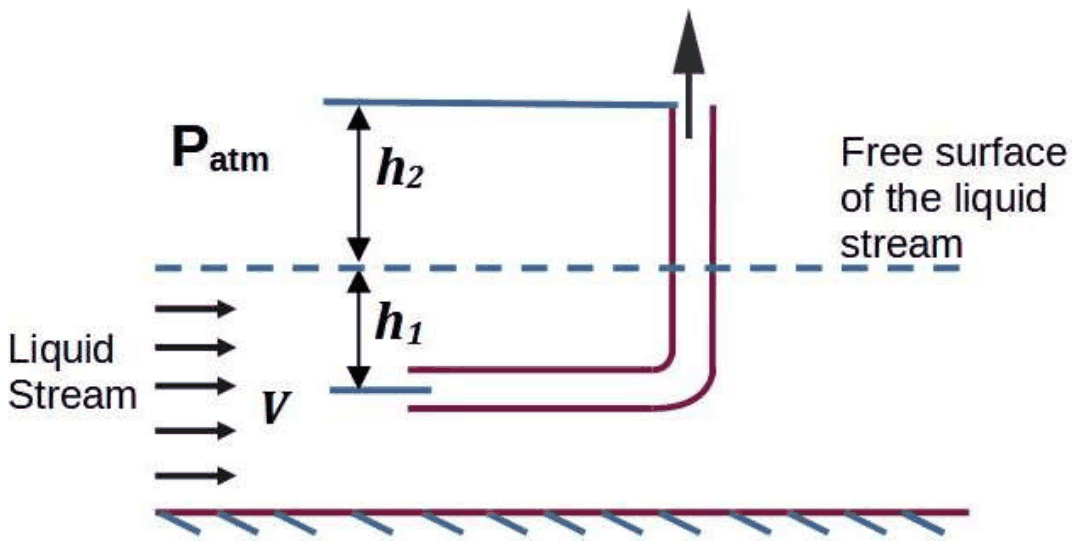
A tube of uniform diameter \(D\) is immersed in a steady flowing inviscid liquid stream of velocity \(V\), as shown in the figure. Gravitational acceleration is represented by \(g\). The volume flow rate through the tube is ______.
Answer: D
The flow rate is \(\tfrac{\pi}{4}D^{2}\sqrt{V^{2} - 2gh_{2}}\).
The flow is steady and inviscid, so Bernoulli's equation holds along the streamline that enters the tube mouth and leaves at the top. Work in heads, with gauge pressure and the free surface as datum. Far upstream at the depth of the mouth, the pressure head is \(h_{1}\), the elevation is \(-h_{1}\) and the speed is \(V\). At the outlet, the pressure head is zero (atmospheric), the elevation is \(h_{2}\) and the speed is \(v\):
\[ \begin{aligned} h_{1} - h_{1} + \frac{V^{2}}{2g} &= h_{2} + \frac{v^{2}}{2g} \\ v &= \sqrt{V^{2} - 2gh_{2}} \end{aligned} \]
The depth \(h_{1}\) cancels: the extra hydrostatic pressure at the mouth exactly offsets the extra height the liquid must climb. Multiplying by the area \(\pi D^{2}/4\) gives the answer.
\(\tfrac{\pi}{4}D^{2}V\) ignores the rise of \(h_{2}\) above the surface. \(\sqrt{2gh_{2}}\) and \(\sqrt{2g(h_{1} + h_{2})}\) treat the liquid as if it fell through a height, when here it is the stream's kinetic energy that lifts it.
Post your comment
Please log in or register to post a comment.
Examination Categories
- SSC Exams
- Banking Exams
- Teaching Exams
- Civil Services Exams
- Railways Exams
- Engineering Recruitment Exams
- Defence Exams
- State Government Exams
- Police Exams
- Insurance Exams
- Nursing Exams
- Other Government Exams
- NRA CET
- PG Entrance Exams
- Campus Placement
- MBA Entrance Exams
- CUET and UG Entrance
- Judiciary Exams
- Regulatory Body Exams
- Software Development