
Discussion
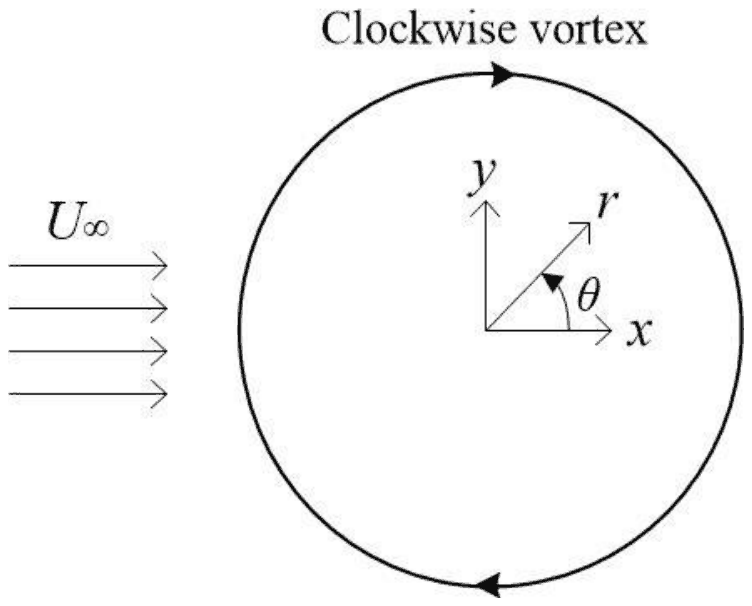
An inviscid steady incompressible flow is formed by combining a uniform flow with velocity \(U_{\infty}\) and a clockwise vortex of strength \(K\) at the origin, as shown in the figure. Velocity potential (\(\phi\)) for the combined flow in polar coordinate \((r, \theta)\) is
Answer: A
The key gives \(\phi = \frac{K\theta}{2\pi} - U_{\infty} r \cos\theta\).
This form uses the sign convention \(\vec{V} = -\nabla\phi\), found in several textbooks. With it, a uniform flow \(U_{\infty}\) in the \(+x\) direction has \(\phi = -U_{\infty}x = -U_{\infty} r\cos\theta\), and a clockwise vortex, whose tangential velocity is \(v_{\theta} = -\frac{K}{2\pi r}\), has
\[ \begin{aligned} v_{\theta} &= -\frac{1}{r}\frac{\partial\phi}{\partial\theta} \\ \Rightarrow \phi &= \frac{K\theta}{2\pi} \end{aligned} \]
Potentials add for combined flows, giving the keyed expression. (With the other convention, \(\vec{V} = \nabla\phi\), every sign flips, \(\phi = U_{\infty}r\cos\theta - \frac{K\theta}{2\pi}\), which describes the same flow.)
The other options cannot be right in either convention. \(U_{\infty} r\sin\theta\) is the stream function of a uniform flow, not its potential, and \(K\ln r\) is the vortex's stream function, while the potential of a vortex depends on \(\theta\).
Post your comment
Please log in or register to post a comment.
Examination Categories
- SSC Exams
- Banking Exams
- Teaching Exams
- Civil Services Exams
- Railways Exams
- Engineering Recruitment Exams
- Defence Exams
- State Government Exams
- Police Exams
- Insurance Exams
- Nursing Exams
- Other Government Exams
- NRA CET
- PG Entrance Exams
- Campus Placement
- MBA Entrance Exams
- CUET and UG Entrance
- Judiciary Exams
- Regulatory Body Exams
- Software Development