
Discussion
Rheological diagram of different types of fluids is shown in figure. Column I represents the nature of the fluid and column II represents the curve showing the variation of shear stress against shear strain rate.
| Column I | Column II |
|---|---|
| (i) Newtonian | M |
| (ii) Shear thinning | N |
| (iii) Shear thickening | O |
| (iv) Bingham plastic | P |
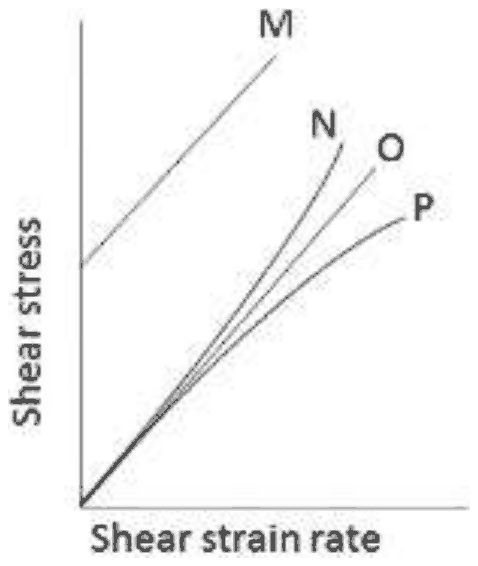
The most appropriate match between columns I and II is,
Answer: B
The match is (i) - O; (ii) - P; (iii) - N; (iv) - M.
- A Newtonian fluid has shear stress proportional to strain rate: a straight line through the origin, curve O.
- A shear-thinning fluid's apparent viscosity falls as the rate rises, so the curve bends down towards the rate axis: P.
- A shear-thickening fluid's viscosity rises with rate, so its curve bends upward: N.
- A Bingham plastic does not flow until a yield stress is exceeded, then behaves linearly: a straight line starting above the origin, M.
Options pairing Newtonian with P, or Bingham plastic with N, put a curved line where a straight one is needed, and the first option swaps thinning and thickening.
No comment is present. Be the first to comment.
Loading…
Post your comment
Please log in or register to post a comment.
Examination Categories
- SSC Exams
- Banking Exams
- Teaching Exams
- Civil Services Exams
- Railways Exams
- Engineering Recruitment Exams
- Defence Exams
- State Government Exams
- Police Exams
- Insurance Exams
- Nursing Exams
- Other Government Exams
- NRA CET
- PG Entrance Exams
- Campus Placement
- MBA Entrance Exams
- CUET and UG Entrance
- Judiciary Exams
- Regulatory Body Exams
- Software Development