
Discussion
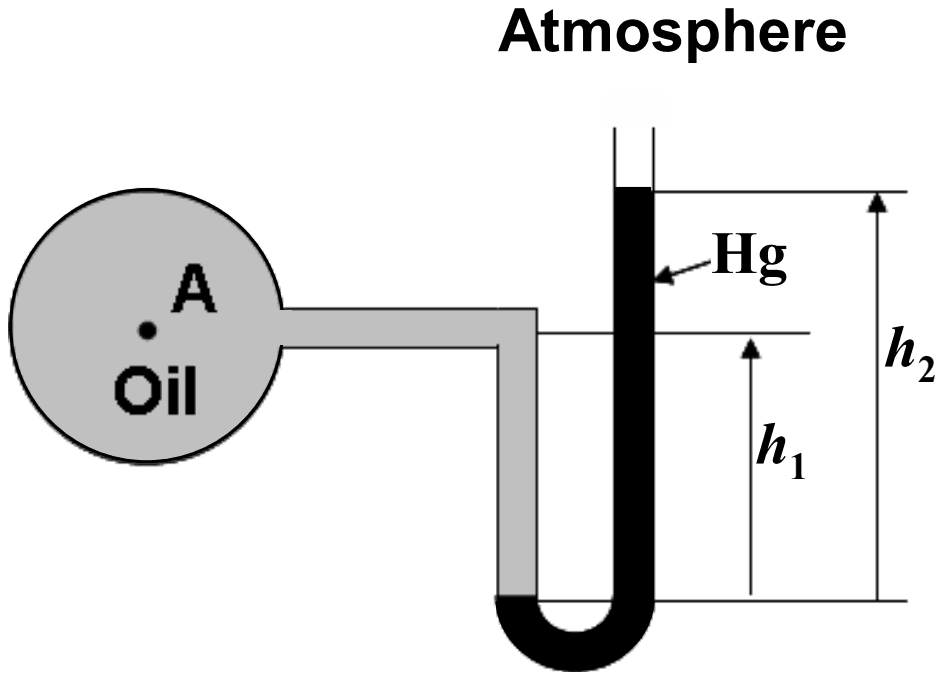
A U-tube mercury (Hg) manometer as shown below is employed to measure the pressure of an oil-filled vessel. The densities of Hg and oil are 13600 kg/m3 and 800 kg/m3, respectively. The gravitational acceleration may be taken as 10 m/s2. The gauge pressure (in Pa) at point A when h1 = 0.5 m and h2 = 0.9 m, is approximately
Answer: A
The gauge pressure at A is about \(118.4 \times 10^{3}\) Pa.
Start at the oil-mercury interface at the bottom of the U. The open limb carries mercury a height \(h_{2}\) above it, open to the atmosphere; the oil side rises \(h_{1}\) from the interface to the level of A. Equating pressures at the interface level:
\[ \begin{aligned} p_{A} + \rho_{oil} g h_{1} &= \rho_{Hg} g h_{2} \\ p_{A} &= 13600(10)(0.9) - 800(10)(0.5) \\ &= 122400 - 4000 = 118400\ \text{Pa} \end{aligned} \]
That is \(118.4 \times 10^{3}\) Pa, about 118 kPa gauge. The options 118.4, 11.84 and 1.184 are the same digits with the wrong power of ten.
Post your comment
Please log in or register to post a comment.
Examination Categories
- SSC Exams
- Banking Exams
- Teaching Exams
- Civil Services Exams
- Railways Exams
- Engineering Recruitment Exams
- Defence Exams
- State Government Exams
- Police Exams
- Insurance Exams
- Nursing Exams
- Other Government Exams
- NRA CET
- PG Entrance Exams
- Campus Placement
- MBA Entrance Exams
- CUET and UG Entrance
- Judiciary Exams
- Regulatory Body Exams
- Software Development